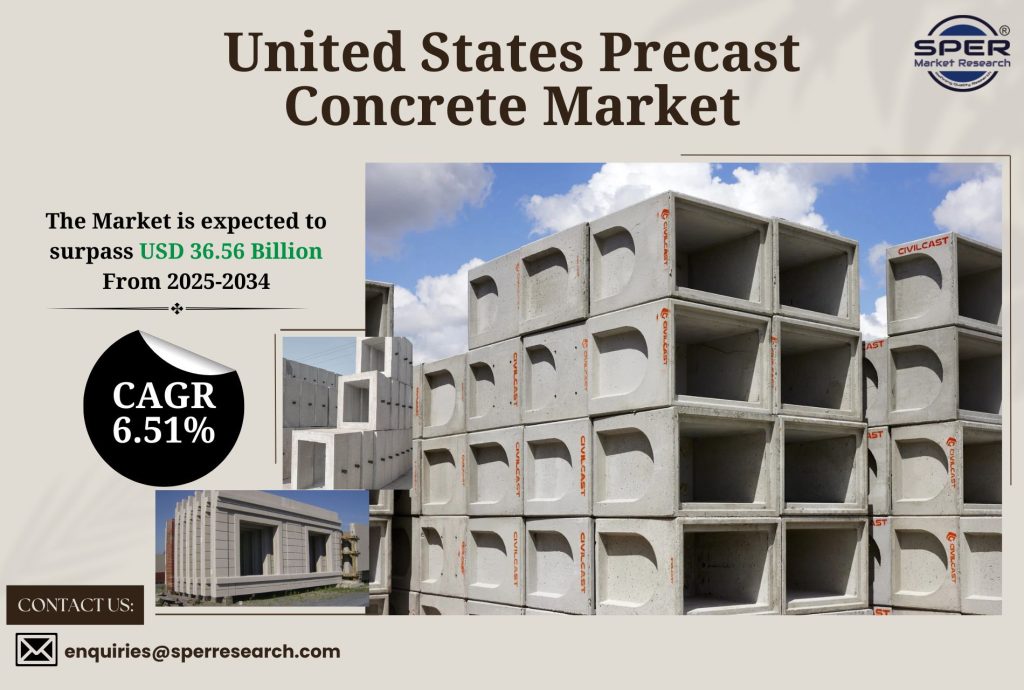
United States Precast Concrete Market Revenue, Trends and Forecast 2034

Precast concrete is made by pouring concrete into a reusable mold or form, allowing it to cure in a controlled setting before being delivered to the building site to be installed. Unlike traditional cast-in-place concrete, precast elements are manufactured off-site, ensuring higher quality, durability, and precision. Common precast products include beams, slabs, walls, columns, and stairs, used across residential, commercial, and infrastructure projects. Faster construction, less labor, and less disturbance on the job site are all made possible with precast concrete. It supports modular building techniques and offers design flexibility, structural strength, and resistance to environmental factors, making it a preferred choice for modern construction needs.

According to SPER Market Research, United States Precast Concrete Market Size- By Type, By Product, By End User- Regional Outlook, Competitive Strategies and Segment Forecast to 2034” states that United States Precast Concrete Market is estimated to reach 36.56 USD billion by 2034 with a CAGR of 6.51%.

Drivers:

The demand for faster, less expensive, and better-quality building solutions is driving the precast concrete industry. Precast elements significantly reduce on-site construction time, allowing for quicker project completion and lower labor costs. Urbanization and infrastructure development, especially in emerging economies, are fueling the need for efficient building materials like precast concrete. Its durability, resistance to weather and seismic activity, and minimal maintenance requirements make it suitable for long-term structures. The material also supports sustainable construction through reduced waste, energy efficiency, and recycling potential. Additionally, advancements in modular construction and architectural flexibility have further increased its adoption across residential, commercial, and industrial sectors, making it a cornerstone in modern construction practices.

Download a Free Report Overview Now

Restraints:

The Precast Concrete market faces several challenges despite its benefits. One of the primary issues is the high initial investment required for manufacturing facilities, molds, and transportation infrastructure, which can deter small and mid-sized builders. Transportation and logistics pose another challenge, as precast elements are often large and heavy, requiring specialized handling and limiting distance from production sites. Design flexibility, while improved, can still be restricted compared to cast-in-place concrete for highly customized projects. Skilled labor is also needed to ensure precise assembly at the construction site. Additionally, lack of awareness or preference for traditional methods in some regions can hinder adoption. Climate-related curing conditions may further impact production efficiency and costs.

Texas held the biggest revenue share in the United States Precast Concrete Market. Due to its rapid population growth, residential and commercial construction boom, and a strong presence of major precast manufacturers like Oldcastle and Tindall operating multiple plants across the state. Some of the key market players are American Precast Concrete, Inc., CEMEX, Concrete Pipe & Precast LLC, Kawneer, Metromont Corporation and NAPCO Precast LLC.

For More Information, refer to below link: –  

United States Precast Concrete Market Growth

Related Reports:  

Floor Screed Market Growth

Traffic Signal Controller Market Growth

Follow Us – 

LinkedIn | Instagram | Facebook | Twitter 

Contact Us: 

Sara Lopes, Business Consultant — USA 

SPER Market Research 

enquiries@sperresearch.com 

+1–347–460–2899
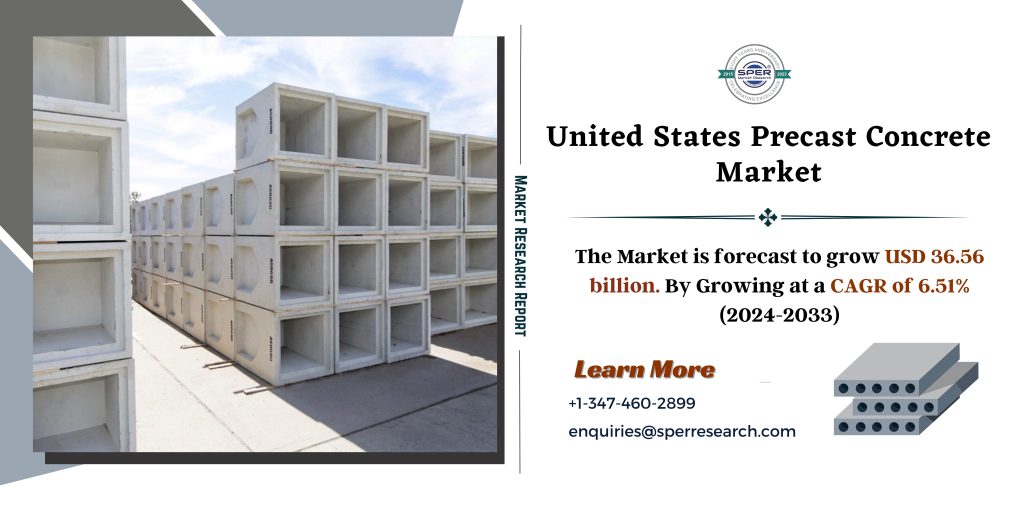
United States Precast Concrete Market

U.S. Precast Concrete Market Size, Trends, Demand, Revenue, Growth Drivers, CAGR Status, Business Opportunities, key Players and Future Outlook 2024-2033: SPER Market Research

Before being transported to the construction site, precast concrete is a form of building material that is created by pouring concrete into a reusable mold and allowing it to cure further in a controlled environment. It can be used for a wide range of purposes, including cladding, bridge decks, septic tanks, drainage systems, walls, beams, columns, fencing, and modular building systems. Precast concrete is an inexpensive, versatile, and incredibly durable product that offers excellent fire, heat, and acoustic resistance. It also allows for quicker installation, superior quality and consistency, and a reduction in constructing time.

United States Precast Concrete Market Overview:

  • Forecast CAGR (2022-2032): 6.51%
  • Forecast Market Size (2032): 36.56 billion

Precast concrete is becoming more and more popular due to rising environmental consciousness and an emphasis on sustainable building techniques. Precast concrete components frequently outlast conventional construction methods and require less maintenance, which lessens the building’s life cycle’s overall environmental effect.  Another factor propelling the industry is the design flexibility of precast concrete. Its malleability permits architects and designers to realize their visions without compromising the structure’s structural integrity. Precast concrete is renowned for being robust and long-lasting. Precast concrete components are frequently chosen in areas vulnerable to natural catastrophes like hurricanes and earthquakes due to their durability and capacity to endure harsh circumstances. This driver is especially important in regions where there has been a history of extreme weather.

Request For Free Sample Report @ https://www.sperresearch.com/report-store/usa-precast-concrete-market.aspx?sample=1

One of the biggest obstacles to the market is the high cost of precast concrete for small-scale projects. Precast concrete products require expensive molds and tools. Precast concrete products require advanced technology and highly skilled people to manufacture. In the short future, growth will probably be limited due to the substantial initial outlay. The price volatility of raw materials is one of the key variables expected to restrict market revenue growth. Precast concrete’s energy and raw material expenses are erratic. Since sand and aggregates are two of the primary raw materials used to make precast concrete products, price fluctuations also have an impact on manufacturers’ profit margins.

Impact of COVID-19 on United States Precast Concrete Market

The COVID-19 pandemic created a great deal of issues and disruptions, which had a significant impact on the precast concrete industry in the US. Construction companies faced financial challenges that exacerbated the market decline by resulting in budget constraints and project cancellations due to project delays and decreased revenue. Precast concrete is mostly in demand because of the delays or halts in construction activity brought on by the pandemic’s associated economic uncertainty and restrictions. As a result, demand for precast concrete products decreased in a number of market segments. The industry’s issues worsened due to a personnel shortage brought on by social distancing policies and safety concerns, which also affected project timelines and productivity.

United States Precast Concrete Market Key Players:

Geographically, Some of the key players are American Precast Concrete, Inc., CEMEX , Concrete Pipe & Precast LLC, Kawneer, Metromont Corporation, NAPCO Precast LLC, Tindall Corporation, Oldcastle Inc.

United States Precast Concrete Market Segmentation:

By Type: Based on the Type, United States Precast Concrete Market is segmented as; Floors and Roofs, Columns and Beams, Stairs and Landing. Walls.

By Product: Based on the Product, United States Precast Concrete Market is segmented as; Structural Building Component, Architectural Building Components, Transportation Products, Water and Waste Handling Products, Others.

By End Use: Based on the End Use, United States Precast Concrete Market is segmented as; Residential and Non-Residential.

By Region: This research also includes data for Northeast, Midwest, South, West -United State.

This study also encompasses various drivers and restraining factors of this market for the forecast period. Various growth opportunities are also discussed in the report.

For More Information, refer to below link:-

United States Precast Concrete Market Share

Related Reports:

Europe Reclamation Sand Market Size– By Process, By Application- Regional Outlook, Competitive Strategies and Segment Forecast to 2033

Europe Precast Concrete Market Size- By Product Type, By End User- Regional Outlook, Competitive Strategies and Segment Forecast to 2033

Follow Us –  

LinkedIn | Instagram | Facebook | Twitter

Contact Us:  

Sara Lopes, Business Consultant – USA

SPER Market Research

enquiries@sperresearch.com

+1-347-460-2899