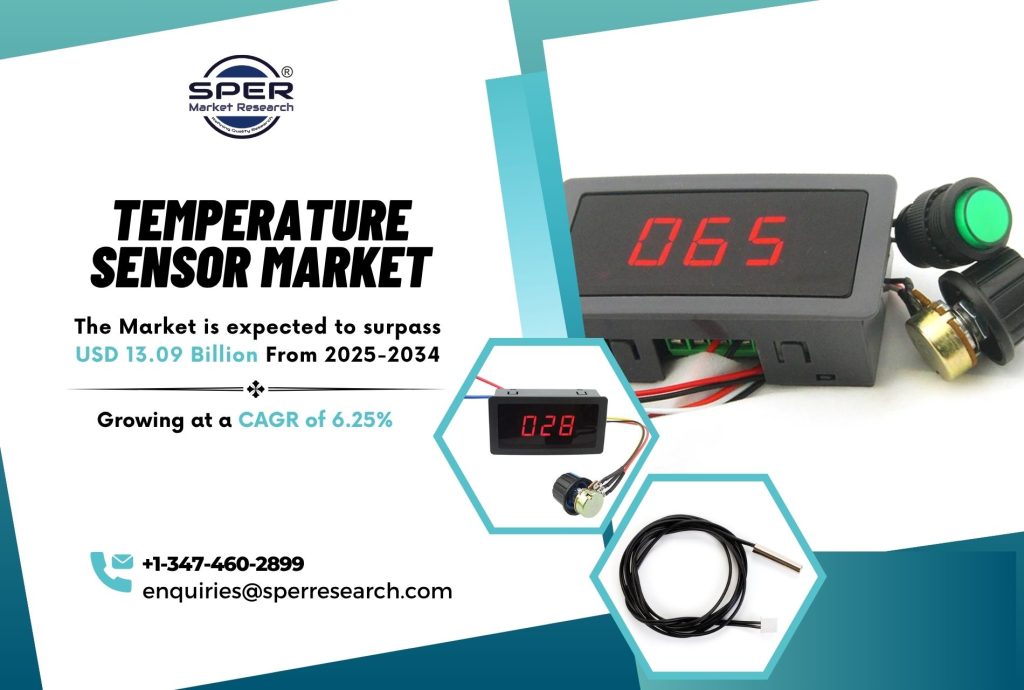
Temperature Sensor Market Size, Share, and Global Outlook

Devices called temperature sensors are employed in a variety of settings and applications to measure and track temperature. They detect changes in temperature and convert this data into readable signals for analysis or control. These sensors come in different types, including thermocouples, resistance temperature detectors (RTDs), thermistors, and infrared sensors, each suited for specific uses. Temperature sensors are widely used in industries such as manufacturing, automotive, healthcare, and consumer electronics to ensure optimal performance, safety, and efficiency. They play a critical role in processes that require precise thermal regulation, such as climate control systems, medical equipment, and industrial automation, ensuring accurate and reliable temperature monitoring.

According to SPER Market Research, states that Global Temperature Sensor Market is estimated to reach 13.09 USD billion by 2034 with a CAGR of 6.25%.

Drivers:

The need for precise, real-time temperature readings in a variety of sectors, including consumer electronics, manufacturing, automotive, and healthcare, is propelling the global market. Temperature sensors are essential for enhancing operating procedures and controlling energy efficiency. The market’s expansion can be ascribed to the growing necessity for industrial automation, improvements in sensor technology, and the growing significance of preserving ideal temperature levels for a range of applications. For instance, Honeywell International has witnessed a significant increase in the use of its cutting-edge temperature sensors because of their potential to improve energy management and facilitate industrial Internet of things (IoT) applications. The need for accurate temperature monitoring is further fueled by the expanding trend of smart homes and connected gadgets.

Request a Free Sample Report: https://www.sperresearch.com/report-store/temperature-sensor-market.aspx?sample=1

Restraints:

The high initial cost of sophisticated sensors is one of the major market barriers, especially in sectors where price sensitivity is an issue. Despite the excellent precision and dependability of these sensors, their price may discourage smaller businesses or those in price-sensitive areas from implementing them. Costs may go up when including cutting edge features like wireless and Internet of Things connectivity. The expensive cost of modern temperature sensors, especially in small-scale operations, may hinder their adoption in some applications, such as pharmaceutical manufacture and food processing. These sectors might opt for less expensive, lower-quality, and less precise temperature sensors in an effort to reduce costs, which could significantly compromise the accuracy and reliability of temperature control. This compromise may lead to suboptimal performance in sensitive applications, potential safety risks, and a higher likelihood of system malfunctions or product defects due to improper thermal regulation.

United States of America held the biggest revenue share in the Global Temperature sensors Market. This dominance is attributed to high adoption rates in various industries like healthcare, aerospace, automotive, and food and beverage. Some of the key market players are STMicroelectronics. NXP Semiconductors, Omega Engineering Inc., Yokogawa Electric Corporation, Murata Manufacturing Co. Ltd., IFM Electronic GmbH and Dwyer Instruments

For More Information, refer to below link: –  

Temperature Sensor Market Growth

Related Reports:  

Global Retail Automation Market Growth

Global SCARA Robots Market Growth

Follow Us – 

LinkedIn | Instagram | Facebook | Twitter 

Contact Us: 

Sara Lopes, Business Consultant — USA 

SPER Market Research 

enquiries@sperresearch.com 

+1–347–460–2899
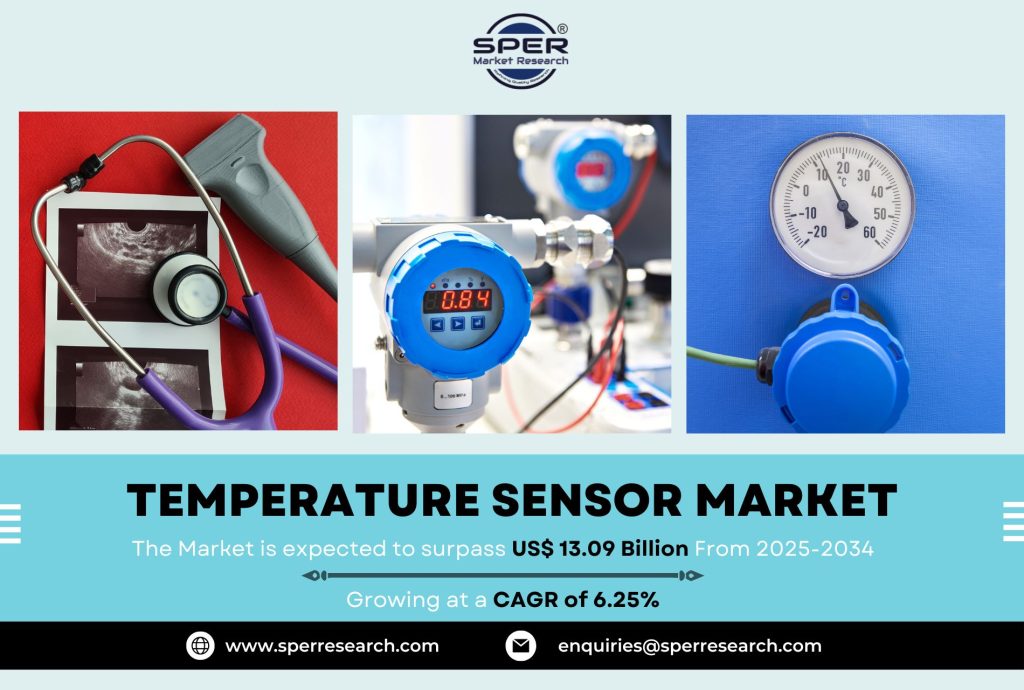
Temperature Sensor Market Share, Demand, Growth, Competition and Future Opportunities Till 2034: SPER Market Research

Temperature sensor is an instrument that measures and detects the ambient temperature and transforms the information into a readable format, typically electrical signals. These sensors work on a number of distinct principles, include infrared radiation (IR sensors), voltage variations (thermocouples), and resistance changes (RTDs and thermistors). They are widely used for temperature monitoring and control in industrial, medical, automotive, and environmental applications. Precise measurements are provided by digital temperature sensors, which are frequently combined with microcontrollers for automation. Thermocouples, thermistors, infrared sensors, resistance temperature detectors (RTDs), and semiconductor-based sensors are common varieties.  In many systems, temperature sensors are essential to ensure performance, safety, and efficiency.

According to SPER market research, Global Temperature Sensor Market Size- By Product, By Output, By Connectivity, By Application – Regional Outlook, Competitive Strategies and Segment Forecast to 2034’ state that the Global Temperature Sensor Market is predicted to reach 13.09 billion by 2034 with a CAGR of 6.25%.

Drivers:

Temperature sensors are used extensively in the automotive industry for a number of purposes, such as climate control systems, battery management in electric vehicles, and engine temperature monitoring. The need for temperature sensors is rising as a result of the growing use of advanced driver assistance systems (ADAS) and electric vehicles (EVs). In order to ensure device safety and optimal performance, the proliferation of consumer electronics, including wearable technology, computers, and smartphones, has increased demand for temperature sensors. By controlling heat dissipation, these sensors help prolong the life of electronic parts. The need for precise and dependable temperature sensors is being driven by the growing significance of remote patient monitoring and the rise in chronic illness.

Request a Free Sample Report: https://www.sperresearch.com/report-store/temperature-sensor-market.aspx?sample=1

Restraints:

It can be quite challenging to maintain high accuracy and precision while measuring temperature. Environmental factors including pressure, humidity, and electromagnetic interference might affect sensor performance, which could lead to errors. As businesses embrace more sophisticated technologies like Industry 4.0 and the Internet of Things, it can be difficult to integrate temperature sensors into these systems. It might be difficult to guarantee ease of use, data security, and interoperability between sensors and other equipment. In harsh environments including high vibration settings, corrosive conditions, and extremely high temperatures, temperature sensors are commonly utilized. It is essential to guarantee sensor longevity and long-term dependability in these settings because malfunctions might result in serious operational disruptions and safety hazards.

The market was dominated by North America. It can be attributed to the growing use of temperature sensors in advanced industries including technology, automotive, and medicine. Some significant market players are STMicroelectronics. NXP Semiconductors, Omega Engineering, Inc., Yokogawa Electric Corporation, Murata Manufacturing Co., Ltd., IFM Electronic GmbH, Dwyer Instruments, LLC, Vishay Intertechnology, Inc.


For More Information, refer to below link: –  

Temperature Sensor Market Growth

Related Reports:  

Desiccant Dehumidifier Market Growth, Size, Trends Analysis – By Product, By Application, By Methods, By Use Cases, By End User – Regional Outlook, Competitive Strategies and Segment Forecast to 2034

Consumer Electronics Market Growth, Size, Trends Analysis – By Product Type, By Distribution Channel – Regional Outlook, Competitive Strategies and Segment Forecast to 2034

Follow Us – 

LinkedIn | Instagram | Facebook | Twitter 

Contact Us: 

Sara Lopes, Business Consultant — USA 

SPER Market Research 

enquiries@sperresearch.com 

+1–347–460–2899