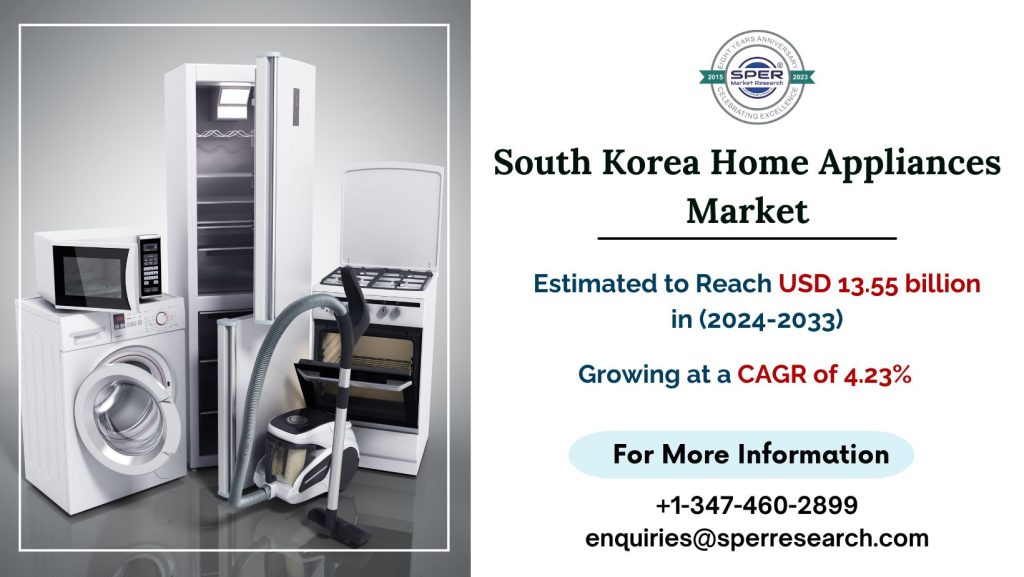
South Korea Home Appliances Market

South Korea Home Appliances Market Growth and Size, Upcoming Trends, Share, Price, Business Challenges, Opportunities and Forecast 2033: SPER Market Research

Home appliances are mechanical or electrical equipment made to help with domestic chores, improving the comfort, efficiency, and convenience of daily life. Cleaning, cooking, heating, cooling, and storing food are among the usual uses for them. Air conditioners, vacuum cleaners, microwave ovens, dishwashers, washing machines, and refrigerators are a few typical examples. These gadgets are designed to save time, lessen physical labor, and enhance household life in general. For example, air conditioners control home temperatures for comfort, washing machines make laundry easier, and refrigerators keep food fresh. Energy-efficient technology are frequently found in modern home appliances to help cut down on electricity use and utility costs. Appliances for the home can be divided into two categories: tiny appliances like coffee makers and blenders, and large appliances like stoves and refrigerators. As smart home technology has advanced, many appliances now have connectivity features that let users monitor and manage them from a distance via voice assistants or smartphones.

According to SPER Market Research, ‘South Korea Home Appliances Market Size- By Product, By Distribution Channel- Regional Outlook, Competitive Strategies and Segment Forecast to 2033’ states that South Korea Home Appliances Market is estimated to reach USD 13.55 billion by 2033 with a CAGR 4.23%.

Due to changing lifestyles, high customer expectations, and technical improvements, the South Korean home appliances market offers substantial prospects. Being a pioneer in technology worldwide, South Korea provides an ideal environment for the development of smart home appliances, such as Internet of Things-enabled air purifiers, washing machines, and refrigerators. Energy-saving appliances are in great demand as consumers look for more ecologically friendly and energy-efficient items. The demand for easy-to-use gadgets, like automatic washing machines, and health-conscious goods, like air purifiers, is also rising as the population ages. The significant demand for high-end, superior appliances with cutting-edge features, durability, and design is partly a result of South Korea’s high level of discretionary income.

Request For Free Sample Report @ https://www.sperresearch.com/report-store/south-korea-home-appliances-market.aspx?sample=1

The home appliance industry in South Korea has many challenges. First and foremost, pricing and market share tactics are made more difficult by fierce competition from both domestic and foreign providers. Second, producers must constantly innovate and follow trends due to the rapid advancement of technology, which can be expensive and time-consuming. Third, when consumer tastes and lifestyles change, businesses need to adjust and provide products that meet a range of needs. Production costs and product availability may be impacted by shifts in the price of raw materials and supply chain interruptions. Strict safety and energy efficiency regulations and standards may also be challenging for manufacturers to meet. Lastly, the general demand for kitchen equipment may be impacted by economic instability.

The COVID-19 epidemic significantly affected consumer behavior and business dynamics in South Korea’s home appliances sector. Demand in the market initially slowed as a result of supply chain and manufacturing disruptions as well as economic uncertainties. While many customers put off making unnecessary purchases, the closing of physical retail locations caused a shift in consumer behavior toward online platforms. But as the epidemic spread, a number of patterns surfaced that had a favorable effect on the market for household equipment. Lockdowns and remote work forced people to spend more time at home, which increased demand for home appliances—especially those that increase comfort and convenience. As more people looked for technologically advanced solutions for energy efficiency, automation, and home management, the epidemic also sped up the adoption of smart home products.

Seoul is dominated in the South Korea Home Appliances Market . Some of the key players are Whirlpool Corporation, Electrolux AB, LG Electronics, Samsung Electronics, Panasonic Corporation,

For More Information, refer to below link:-

South Korea Home Appliances Market Outlook

Related Reports:

UAE Cybersecurity Market Growth, Size, Trends Analysis- By Security Type, By Component, By End User Industry- Regional Outlook, Competitive Strategies and Segment Forecast to 2033

North America Soft Facility Management Market Growth, Size, Trends Analysis- By Type, By End User- Regional Outlook, Competitive Strategies and Segment Forecast to 2033

Follow Us –  

LinkedIn | Instagram | Facebook | Twitter

Contact Us:  

Sara Lopes, Business Consultant – USA

SPER Market Research

enquiries@sperresearch.com

+1-347-460-2899

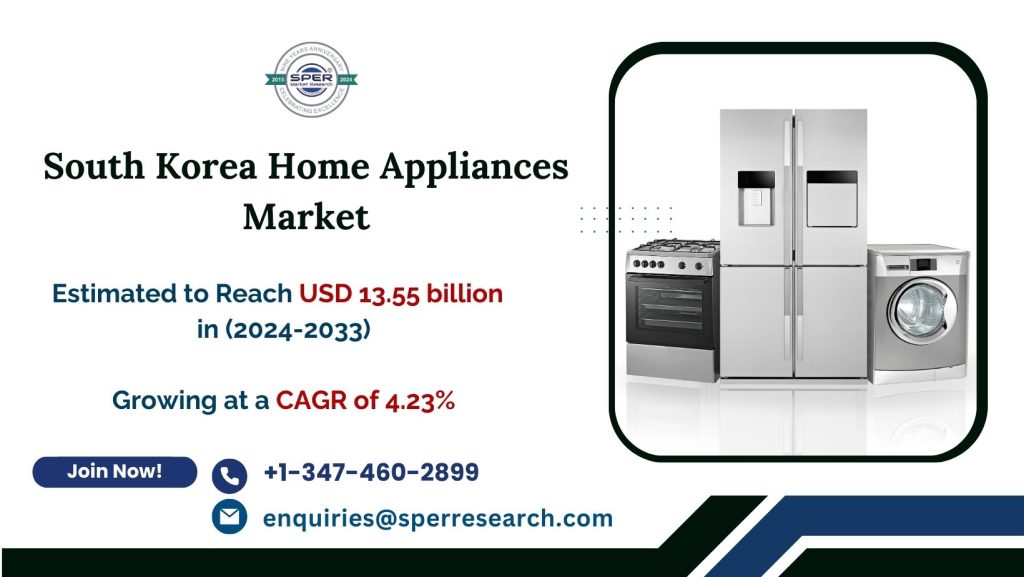
South Korea Home Appliances Market

South Korea Home Appliances Market Size 2024, Revenue, Growth, Share, CAGR Status, Upcoming Trends, Key Players, Opportunities and Future Outlook 2033: SPER Market Research

Home appliances encompass a wide range of equipment designed to make daily tasks easier. They speed up operations, save time, and improve the overall functionality of households and companies. Home appliances, often known as household appliances, are electrical or mechanical devices developed for use in homes to aid in various domestic tasks and improve the convenience and comfort of daily life. These appliances are an essential component of modern homes, serving a number of purposes. Common appliances include refrigerators, washing machines, ovens, microwaves, vacuum cleaners, air conditioners, dishwashers, and various other household equipment.

According to SPER Market Research, South Korea Home Appliances Market Size – By Product, By Distribution Channel – Regional Outlook, Competitive Strategies and Segment Forecast to 2033’ states that the South Korea Home Appliances Market is estimated to reach USD 13.55 billion by 2033 with a CAGR of 4.23%.

Drivers: The market is primarily driven by changing consumer preferences, urbanisation, and an increasing number of people living in smaller rooms and flats. Furthermore, rising government initiatives and regulations promoting energy efficiency have had a significant impact on encouraging the adoption of environmentally friendly and technologically advanced appliances, thereby impacting the entire sector. Furthermore, the market is experiencing a surge in demand for smart appliances that provide connectivity and automation, allowing users to remotely control and monitor their devices, which is another growth driver. Furthermore, continual innovation in product design, functionality, and smart technology integration has encouraged consumers to acquire appliances with cutting-edge features and connection.

Request For Free Sample Report @ https://www.sperresearch.com/report-store/south-korea-home-appliances-market.aspx?sample=1

Restraints: There are various challenges in the South Korean home appliance industry. First and foremost, fierce rivalry from domestic and international suppliers challenges market share and pricing tactics. Second, rapid technological advancement necessitates ongoing innovation and trend-following on the part of manufacturers, which can be expensive and time-consuming. Third, businesses must adapt and provide products that meet a wide range of demands in response to shifting consumer tastes and lifestyles. Changes in raw material pricing, as well as supply chain interruptions, can affect manufacturing costs and product availability. Manufacturers may also face difficulty in meeting stringent safety and energy efficiency regulations and norms. Finally, economic instability may influence total demand for kitchen appliances.

The COVID-19 outbreak has had a substantial impact on South Korea’s home equipment industry. Individuals are spending more time at home and preparing their meals, increasing demand for household equipment. Consumers have purchased gadgets like refrigerators, ovens, microwaves, and dishwashers to improve their cooking experience and convenience. However, due to the economic crisis and financial concerns, a drop in consumer spending has slowed overall market growth. Disruptions in the global supply chain have also caused production and delivery delays for appliances. Despite this, changes in customer behaviour and tastes have opened up new chances for manufacturers to innovate and meet evolving consumer expectations.

South Korea Home Appliances Market Key Players:

South Korea’s home appliance industry is geographically varied, with large demand centres in cities such as Seoul, Busan, and Incheon. Higher urbanisation rates result in greater demand for household appliances due to increased disposable incomes and modern lifestyles. Whirlpool Corporation, Electrolux AB, LG Electronics, Samsung Electronics, Panasonic Corporation, Haier Electronics Group Co Ltd, and others are among the market’s leading rivals.

South Korea Home Appliances Market Segmentation:

By Product: Based on the Product, South Korea Home Appliances Market is segmented as; Major Appliances, Small Appliances.

By Distribution Channel: Based on the Distribution channel, South Korea Home Appliances Market is segmented as; Supermarkets and Hypermarkets, Specialty Stores, E-commerce, and Others.

By Region: This research also includes data for Seoul Capital Area, Yeongnam (Southeastern Region), Honam (Southwestern Region), Hoseo (Central Region).

This study also encompasses various drivers and restraining factors of this market for the forecast period. Various growth opportunities are also discussed in the report.

For More Information, refer to below link:-

South Korea Home Appliances Market Outlook

Related Reports:

United States Facility Management Market Size- By Type of Facility Management Type, By Offering, By End User- Regional Outlook, Competitive Strategies and Segment Forecast to 2033

Russia Home Appliances Market Size– By Major Appliances, By Minor Appliances, By Distribution Channel- Regional Outlook, Competitive Strategies and Segment Forecast to 2033

Follow Us –  

LinkedIn | Instagram | Facebook | Twitter

Contact Us:  

Sara Lopes, Business Consultant – USA

SPER Market Research

enquiries@sperresearch.com

+1-347-460-2899