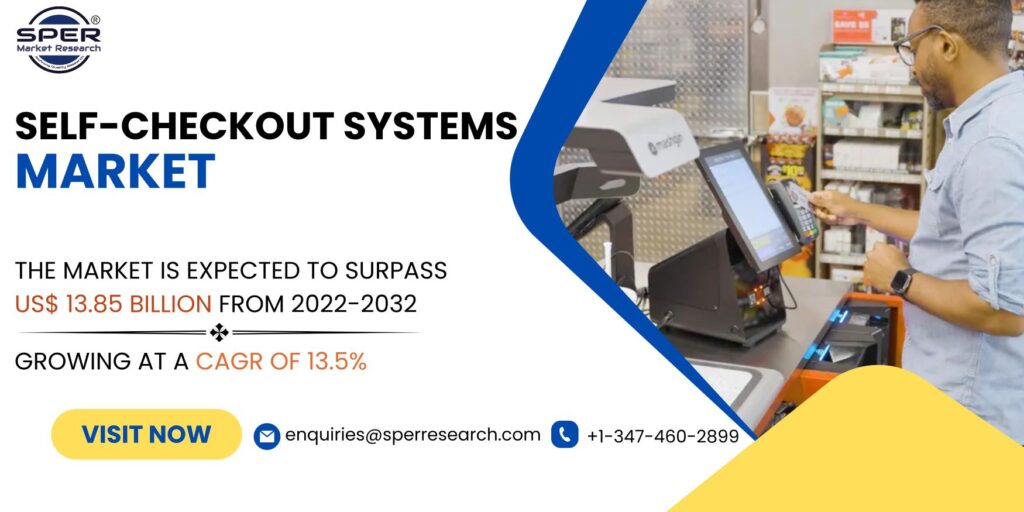
Self-checkout systems are automated machines or software applications that allow customers to independently scan, bag, and pay for their purchases without the need for a cashier. These systems typically consist of a barcode scanner, a weighing scale for items without barcodes, a payment terminal, and a bagging area. Customers scan the barcodes of their items, bag them, and complete the transaction by making payment through cash, credit/debit cards, or mobile payment methods
According tlo SPER market research, ‘Self-Checkout Systems Market Size- By Type, By Mounting Type, By Sales Channel, By Model Type, By Application, By End User – Regional Outlook, Competitive Strategies and Segment Forecast to 2032’ state that the Self-Checkout Systems Market is predicted to reach USD 13.85 billion by 2032 with a CAGR of 13.5%.
Self-checkout systems have experienced significant growth due to their convenience and efficiency, allowing customers to scan and pay for items themselves and avoid long queues. These systems also reduce labour costs for retailers, as fewer cashiers are required, leading to cost savings and increased operational efficiency. They enhance the customer experience by providing faster checkout and a sense of control. The growing retail industry, driven by rising incomes and changing preferences, has contributed to the popularity of self-checkout systems. Technological advancements, such as barcode scanning and AI-powered computer vision, have improved their functionality and adoption
The global self-checkout systems market faces challenges such as high upfront costs for retailers, technical issues and reliability concerns, security vulnerabilities, ensuring a positive user experience and ease of use, integration with existing systems, and overcoming staff and customer resistance. Implementing self-checkout systems requires significant investment, and technical glitches can disrupt operations. Security measures are necessary to prevent theft and fraud. User-friendly interfaces are essential, and integration with existing systems can be complex. Staff may resist due to job concerns, while some customers prefer human interaction. Overcoming these challenges requires effective communication, training, and addressing concerns from both staff and customers.
Request For Free Sample Report @ https://www.sperresearch.com/report-store/self-checkout-systems-market.aspx?sample=1
Impact of COVID-19 on Self-Checkout Systems Market
The COVID-19 pandemic has driven the growth of e-commerce and omnichannel retailing, with more consumers shifting to online shopping. Self-checkout systems have adapted to support online order pickups, enabling efficient retrieval of purchases in physical stores and enhancing retailers’ omnichannel capabilities. The pandemic has also spurred technological advancements and innovation in self-checkout systems, including mobile apps, scan-and-go technologies, and AI-powered systems, aimed at improving the user experience, security, and streamlining the checkout process. However, the self-checkout systems market faced supply chain disruptions due to lockdowns, travel restrictions, and manufacturing delays, resulting in supply shortages and increased lead times for providers, impacting the deployment of new systems and the expansion plans of retailers.
Self-Checkout Systems Market Key Players:
Geographically, North America emerged as the dominant region in the Self-Checkout Systems market. The increasing use of self-checkout systems by Canadian and American hypermarkets and supermarkets aided regional sector growth. The key cause for the unfilled employment gap in the United States is employee desire for a better pay range. The need for self-checkout systems is increasing across all physical shop forms, owing to the increasing demand for staff at an optimised pay range. Additionally, some of the market key players are Erply, Fujitsu Ltd., Gilbarco Inc., IBM Corporation, IER Inc., ITAB Group, Others.
Self-Checkout Systems Market Segmentation:
The SPER Market Research report seeks to give market dynamics, demand, and supply forecasts for the years up to 2033. This report contains statistics on product type segment growth estimates and forecasts.
| By Mounting Type: | · Mobile
· Stand-Alone Mounting Type · Wall-Mounting & Countertop Mounting Type |
| By Sales Channel: | · Direct Channel
· Indirect Channel |
| By Model Type: | · Cash Model Type
· Cashless Model Type |
| By Application: | · Healthcare
· Hospitality · Retail · Travel |
| By End User: | · Convenience Store
· Hospitality · Hypermarkets & Departmental Stores · Retail · Supermarkets |
| By Region: | · North America
· Europe · Asia-Pacific |
This study also encompasses various drivers and restraining factors of this market for the forecast period. Various growth opportunities are also discussed in the report.
For More Information, refer to below link:-
Self-Checkout Systems Market Future Outlook
Related Reports:
Follow Us –
LinkedIn | Instagram | Facebook | Twitter
Contact Us:
Sara Lopes, Business Consultant – U.S.A.
SPER Market Research
+1-347-460-2899
