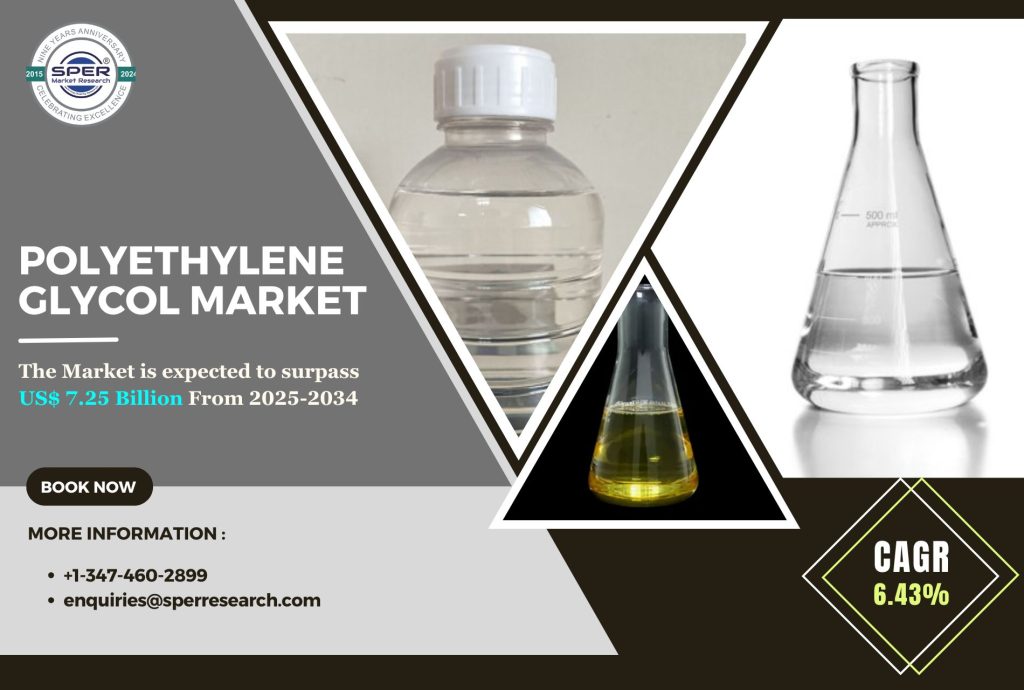
Polyethylene Glycol Market Demand, Scope, Share and Future Opportunities 2034

Polyethylene glycol (PEG) is a versatile, water-soluble polymer widely used in various industries, including pharmaceuticals, cosmetics, food, and manufacturing. Composed of repeating ethylene oxide units, PEG is non-toxic, non-irritating, and available in different molecular weights, influencing its physical and chemical properties. In the pharmaceutical industry, PEG acts as a solvent, drug delivery vehicle, and excipient. It is also used in cosmetics as a moisturizer and thickener, and in industrial applications as a lubricant and anti-foaming agent. Its biocompatibility and solubility make it ideal for medical and scientific use. PEG plays a critical role in both everyday products and advanced biomedical applications.

According to SPER Market Research, “Global Polyethylene Glycol Market Size- By Grade, By Application, By Molecular Weight, By Source, By End Use Industry – Regional Outlook, Competitive Strategies and Segment Forecast to 2034” states that Global Polyethylene glycol Market is estimated to reach 7.25 USD billion by 2034 with a CAGR of 6.43%.

Drivers:

Polyethylene glycol (PEG) is witnessing growing demand due to its versatile applications across multiple industries. In the pharmaceutical sector, PEG is widely used as a solvent, stabilizer, and binder in drug formulations, as well as a key component in drug delivery systems, driving its market growth. In the personal care industry, PEG serves as a specialty solvent, surface-active agent, and emulsifier in products like shampoos, creams, and lotions, further boosting its demand. Additionally, the increasing shift toward sustainable and eco-friendly products is accelerating the adoption of bio-based PEGs as alternatives to petroleum-based versions. Rapid industrialization and the expansion of the healthcare sector in emerging markets such as China and India are also significantly contributing to PEG consumption.

Request a Free Sample Report: https://www.sperresearch.com/report-store/polyethylene-glycol-market.aspx?sample=1

Restraints:

The global polyethylene glycol (PEG) market faces several key restraints that could hinder its growth. Environmental and regulatory concerns are rising, particularly due to the non-biodegradable nature of petroleum-based PEGs, prompting stricter regulations. Volatility in raw material prices, especially ethylene oxide derived from crude oil, affects production costs and market stability. Health and safety issues also pose challenges, as certain PEG formulations may contain harmful impurities like 1,4-dioxane, limiting their use in consumer products. Additionally, the availability of natural and plant-based substitutes in industries such as cosmetics, pharmaceuticals, and food is reducing reliance on PEG. Supply chain disruptions have also impacted the timely availability and distribution of PEG products across global markets.

China held the biggest revenue share in the Global polyethylene glycol Market. This dominance is attributed to various factors, including its robust industrial growth, particularly in sectors like pharmaceuticals, automotive, and construction. Some of the key market players are BASF, Dow Chemical Company, LOTTE CHEMICAL, Ineos, Croda and Liaoning Oxiranchem.

For More Information, refer to below link: –  

Polyethylene Glycol Market Growth

Related Reports:  

Global Expanded Polypropylene Foam Market Growth

Global Polyvinyl Chloride Resin Market Growth

Follow Us – 

LinkedIn | Instagram | Facebook | Twitter 

Contact Us: 

Sara Lopes, Business Consultant — USA 

SPER Market Research 

enquiries@sperresearch.com 

+1–347–460–2899
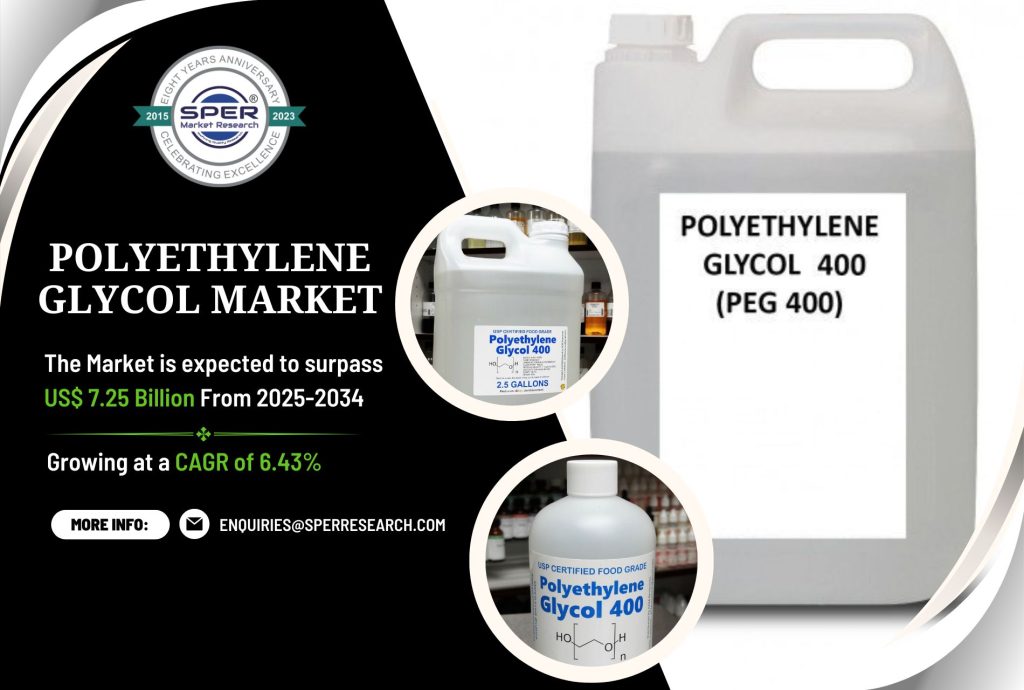
Polyethylene Glycol Market Demand, Trends, Growth, Analysis and Futhure Opportunities: SPER Market Research

Polyethylene glycol (PEG) is a versatile polymer that is widely employed in a variety of sectors due to its distinct chemical and physical features. It is a water-soluble molecule with a linear structure made up of repeating ethylene oxide units, which makes it ideal for a wide range of applications. PEG is noted for being non-toxic, biocompatible, and hydrophilic, making it ideal for usage in pharmaceuticals, cosmetics, and personal care products. In medicine, it is used as a laxative, medication carrier, and excipient in formulations. PEG also has industrial applications, such as lubricant, surfactant, and anti-foaming agent. Its capacity to change surfaces and increase solubility broadens its application in biotechnology and chemical industries.

According to SPER market research, ‘Global Polyethylene Glycol Market Size- By Grade, By Application, By Molecular Weight, By Source, By End Use Industry – Regional Outlook, Competitive Strategies and Segment Forecast to 2034’ state that the Global Polyethylene Glycol Market is predicted to reach 7.25 billion by 2034 with a CAGR of 6.43%.

Drivers:

PEG is widely utilized as an excipient, laxative, and moisture-retaining agent in the pharmaceutical and personal care industries, therefore rising demand is a primary driver. The increasing emphasis on healthcare and cleanliness, particularly in developing countries, fuels demand. In cosmetics, PEG’s position as an emulsifier and stabilizer corresponds to the increased customer demand for high-quality, multifunctional skincare and haircare products. Furthermore, advances in biotechnology and medication delivery techniques are broadening PEG’s use in specialized medical disciplines. Its non-toxic, biodegradable nature, as well as regulatory clearances, make it appealing in environmentally sensitive countries, resulting in steady global acceptance.

Request a Free Sample Report: https://www.sperresearch.com/report-store/polyethylene-glycol-market.aspx?sample=1

Restraints:

One key concern is the variable cost of raw materials, such as ethylene oxide, which has a direct impact on production costs and market prices. Environmental concerns over PEG manufacturing and disposal provide further problems, as stronger regulations and a growing desire for sustainable alternatives emerge. Furthermore, the advent of alternatives in specific applications, such as bio-based polymers, raises competitive pressures. PEG’s penetration and growth potential are further limited in emerging nations due to a lack of awareness of its benefits. Finally, handling and storage constraints, particularly in industrial settings where PEG’s hygroscopic characteristic can cause moisture problems, impede its broad use.

Asia Pacific region dominated the market, accounting for approximately more than 48% of revenues. This is due to the pharmaceutical, automotive, and construction industries’ rapid rise in India and China. Some significant market players are BASF SE, Dow Chemical Company, INEOS Group Limited, LyondellBasell Industries Holdings B.V, SABIC, and others.

For More Information, refer to below link: –  

Polyethylene Glycol Market Growth

Related Reports:  

Biodegradable Plastics Market Growth, Size, Trends Analysis – By Product, By Application – Regional Outlook, Competitive Strategies and Segment Forecast to 2034

Ammonia Market Growth, Size, Trends Analysis – By Product, By Application – Regional Outlook, Competitive Strategies and Segment Forecast to 2034


Follow Us – 

LinkedIn | Instagram | Facebook | Twitter 

Contact Us: 

Sara Lopes, Business Consultant — USA 

SPER Market Research 

enquiries@sperresearch.com 

+1–347–460–2899