Leather Dyes and Chemicals Market

Leather Dyes and Chemicals Market Trends, Share, Revenue, Growth Drivers, Business Challenges, Opportunities and Future Competition till 2032: SPER Market Research

According to the chemical, leather dyes are the colours that are mostly used on leather. Water-soluble colours and non-water-soluble dyes make up the two categories into which these leather dyes are divided. Among the non-water-soluble sulphur dyes are those that dissolve in an aqueous solution of sulphur dioxide. Water-soluble dyes include anionic acid dyes, direct dyes, special leather dyes, atmospheric metal complex dyes, and triphenylmethane dyes of sulfite. Aniline and Nappa leather with minimal or no finishing have been popular choices for light leather in recent years.

According to SPER Market Research, ‘Leather Dyes and Chemicals Market Size- By Product Type, By Application, By Type of Leather Dyes, By Type of Leather Chemicals, By Leather Chemicals Processing- Regional Outlook, Competitive Strategies and Segment Forecast to 2032’ states that the Leather Dyes & Chemicals Market is estimated to reach USD 14.44 billion by 2032 with a CAGR of 7.03%. 

The manufacturing of shoes and leather goods has led to the widespread acceptance and appeal of these dyes. Better growth potential is anticipated for the leather dye market from people’s increased desire for shoes and bags in different shoe sizes, designs, and styles. The market for paints and coatings is growing as a result of the growing demand for a variety of colours in the goods that are already accessible. Most leather dyes are made with spirit- or alcohol-based pigments, which quickly seep into the wet leather. The ingredients for dyeing leather are the same as those used to make lacquers: a pigment or dye, nitrocellulose or casein resin, and solvent.  

The use and disposal of chemicals pose a number of environmental difficulties for the leather dyes and chemicals market. Regulations pertaining to specific chemicals have an impact on product compositions and production procedures, which complicates business operations. Major challenges for firms also include shifting raw material pricing and supply chain interruptions. It is a constant struggle to satisfy consumer needs for environmentally friendly and sustainable products while upholding standards of performance and quality. In order to meet such challenges, creativity, teamwork, and a dedication to sustainability along the entire value chain are needed. 

Request For Free Sample Report @ https://www.sperresearch.com/report-store/leather-dyes-and-chemicals-market.aspx?sample=1

Impact of COVID-19 on the Global Leather Dyes & Chemicals Market

The global economy has suffered due to the COVID-19 pandemic, which has also had an adverse effect on consumer purchasing patterns. In an effort to curb the virus’s spread, travel restrictions have been implemented. The availability of raw materials required to create leather has decreased as a result of these restrictions, which has negatively impacted the market’s expansion throughout the pandemic. Less chemicals are used in the production of leather goods, and fewer of them are exported as a result of COVID-19. The temporary closure of mills that produce leather has also hampered the growth of the leather chemicals sector.  

Leather Dyes & Chemicals Market Key Players:

Due to the sharp rise in rapidly industrialising nations like China and India, the Asia Pacific region is the world’s biggest and most profitable market for leather dyes and chemicals. Some of the major players in this sector include BASF, Bayer AG, Brother Enterprises, Chemtan Company Inc., Dowell Science Technology, DyStar, Elementis plc., Lanxess AG, Lawrence Industries Limited, Schill and Seilacher, Sichuan Decision Chemical, Sisecam, Stahl International B.V., and Texapel. 

Leather Dyes & Chemicals Market Segmentation:

The SPER Market Research report seeks to give market dynamics, demand, and supply forecasts for the years up to 2032. This report contains statistics on product type segment growth estimates and forecasts.

By Product Type: Based on the Product Type, Global Leather Dyes & Chemicals Market is segmented as; Beamhouse Chemicals, Fat liquors, Finishing Agent, Syntans, Others.

By Application: Based on the Application, Global Leather Dyes & Chemicals Market is segmented as; Bags Manufacturing Industry, Leather Industry, Shoes Manufacturing Industry.

By Type of Leather Dyes: Based on the Type of Leather Dyes, Global Leather Dyes & Chemicals Market is segmented as; Acid Dyes, Basic Dyes, Direct Dyes, Mordant Dyes, Pre-metaled Dyes, Sulphur Dyes, Others.

By Type of Leather Chemicals: Based on the Type of Leather Chemicals, Global Leather Dyes & Chemicals Market is segmented as; Biocides, Chromium Sulphate, Polyurethane Resins, Sodium Bicarbonate, Surfactants, Others.

By Leather Chemicals Processing: Based on the Leather Chemicals Processing, Global Leather Dyes & Chemicals Market is segmented as; Tanning & Dyeing, Beamhouse, Finishing Chemicals.

By Region: Due to the fast industrialization of nations like China and India, high levels of pollution, rising disposable income, and the emergence of new multinational leather companies, the Asia Pacific region is the world’s largest and most lucrative market for leather dyes and chemicals. The highest CAGR is anticipated for the Asia Pacific area during the projection period.

This study also encompasses various drivers and restraining factors of this market for the forecast period. Various growth opportunities are also discussed in the report.

For More Information, refer to below link:-

Leather Chemicals Market Future Outlook

Related Reports:

Europe Wood Plastic Composite Market Size- By Application- Regional Outlook, Competitive Strategies and Segment Forecast to 2033

Polyethylene Terephthalate (PET) Market Size- By Type, By Application- Regional Outlook, Competitive Strategies and Segment Forecast to 2033

Follow Us –

LinkedIn | Instagram | Facebook | Twitter

Contact Us:

Sara Lopes, Business Consultant – U.S.A.

SPER Market Research

enquiries@sperresearch.com

+1-347-460-2899

Leather Dyes and Chemicals Market

Leather Dyes and Chemicals Market Size 2023, Growth, Rising Trends, Revenue, Industry Share, Challenges, Future Opportunities and Forecast Analysis till 2032: SPER Market Research

The tanning, retanning, and coloring processes for leather processing involve the use of leather chemicals. These materials are primarily utilized to provide leather replacements increased suppleness, increased dryness, increased resistance to abrasion, and improved physical attributes. The four primary categories of leather chemicals are dyeing chemicals, beam house chemicals, retanning and filling chemicals, and tanning and dyeing chemicals. To transform raw hide into leather, tanning agents such as vegetable tannins, mineral salts, and animal oils are employed. To improve the suppleness and suppleness of leather, tanning and filling processes use acrylic dispersions. To moisten dyes and remove oil or fats from hides or leather, coloring chemicals such as surfactants, degreasers, sodium formate, and neutralizing systems are utilized.

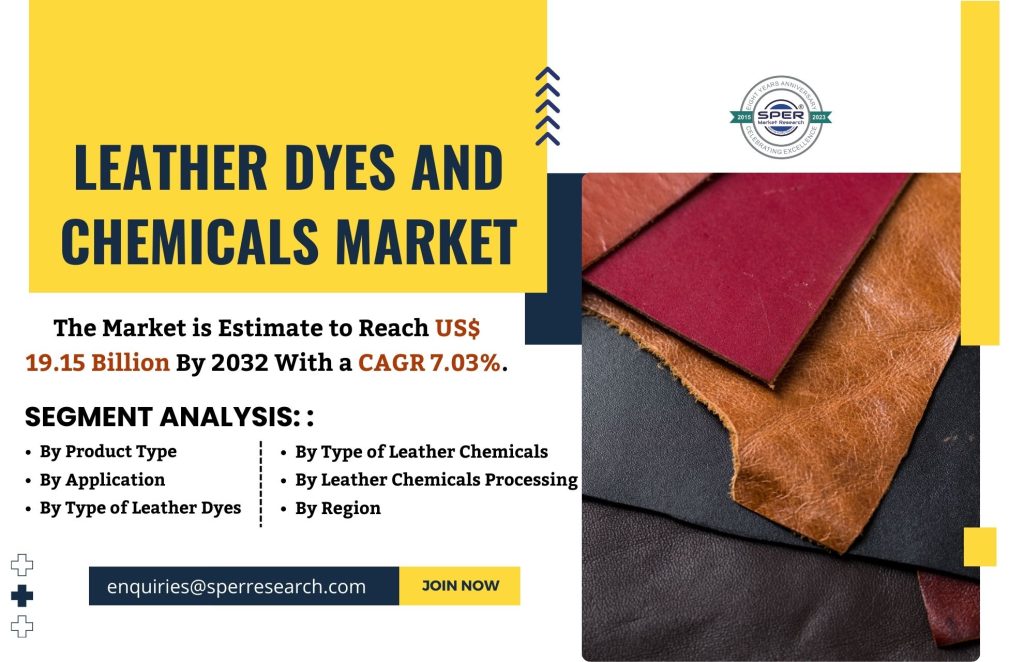
According to SPER market research, Leather Dyes And Chemicals Market Size– By Product Type, By Application, By Type Of Leather Chemicals, By leather chemical Processing-Regional Outlook, Competitive Strategies and Segment Forecast to 2032’ state that the Leather Dyes and Chemicals Market is predicted to reach USD 19.15 billion by 2033 with a CAGR of 7.03%.

Spirit- or alcohol-based dyes are typically used to dye leather since the alcohol quickly absorbs into the wet leather. The ingredients for dyeing leather are the same as those used to make lacquers: a pigment or dye, nitrocellulose or casein resin, and solvent. To enhance the smoothness, textures, and shine of dry leather apparel and other materials, leather dyes are also used. The market is expanding as a result of the rising demand for leather dye in developing nations from the leather industry. Consumer interest is being piqued by the chemical industry’s expanding global R&D and innovation activities as well as the availability of products in a variety of hues, including red, brown, black, and others.

Unpredictability in raw material pricing might lead to instability in the production of these compounds. The effects of these compounds’ production methods on the environment are also a major source of worry. Furthermore, shifts in fashion trends have a big impact on leather demand, which impacts the stability of the industry.

Request For Free Sample Report @ https://www.sperresearch.com/report-store/leather-dyes-and-chemicals-market.aspx?sample=1

Impact of COVID-19 on the Global Leather Dyes & Chemicals Market

The demand for leather textiles and footwear declined as a result of market and retail unit closures during the Covid-19 pandemic, which had a detrimental influence on the leather chemicals market globally. Restrictions on travel and the transportation of goods upset the supply chain, affecting both manufacturers and consumers. In the meantime, a lack of labor and raw materials caused the leather industry to see a decline in output. Both the export of leather goods and the use of leather chemicals in their production have decreased as a result of COVID-19. The temporary closure of leather manufacturing facilities has had an additional effect on the market for leather chemicals.

Leather Dyes & Chemicals Market Key Players:

Geographically, Asia-Pacific, accounted for the largest revenue share due to its superior and effective performance. The growth of the leather dyes and chemicals market and the emergence of significant companies in the Middle East & Africa markets are also contributing to the expansion. Furthermore, it is projected that the market’s power will improve and operations with the least complex procedures will benefit from the growing acceptance of the leather dyes and chemicals market. In addition, BASF, Bayer AG, Brother Enterprises, Chemtan Company Inc., Dowell Science Technology, DyStar, Elementis plc., Lanxess AG,  Others.

Leather Dyes & Chemicals Market Segmentation:

The SPER Market Research report seeks to give market dynamics, demand, and supply forecasts for the years up to 2032. This report contains statistics on product type segment growth estimates and forecasts.

By Product Type: Based on the Product Type, Global Leather Dyes & Chemicals Market is segmented as; Beamhouse Chemicals, Fat liquors, Finishing Agent, Syntans, Others.

By Application: Based on the Application, Global Leather Dyes & Chemicals Market is segmented as; Bags Manufacturing Industry, Leather Industry, Shoes Manufacturing Industry.

By Type of Leather Dyes: Based on the Type of Leather Dyes, Global Leather Dyes & Chemicals Market is segmented as; Acid Dyes, Basic Dyes, Direct Dyes, Mordant Dyes, Pre-metaled Dyes, Sulphur Dyes, Others.

By Type of Leather Chemicals: Based on the Type of Leather Chemicals, Global Leather Dyes & Chemicals Market is segmented as; Biocides, Chromium Sulphate, Polyurethane Resins, Sodium Bicarbonate, Surfactants, Others.

By Leather Chemicals Processing: Based on the Leather Chemicals Processing, Global Leather Dyes & Chemicals Market is segmented as; Tanning & Dyeing, Beamhouse, Finishing Chemicals.

By Region: Due to the fast industrialization of nations like China and India, high levels of pollution, rising disposable income, and the emergence of new multinational leather companies, the Asia Pacific region is the world’s largest and most lucrative market for leather dyes and chemicals. The highest CAGR is anticipated for the Asia Pacific area during the projection period.

This study also encompasses various drivers and restraining factors of this market for the forecast period. Various growth opportunities are also discussed in the report.

For More Information, refer to below link:-

Leather Dyes & Chemicals Market Revenue

Related Reports:

Concrete Floor Coatings Market Size- By Products, By Component, By Application, By End Use- Regional Outlook, Competitive Strategies and Segment Forecast to 2033

Lithium Titanate Oxide Battery Market Size- By Component, By Material, By Capacity, By Voltage, By Application- Regional Outlook, Competitive Strategies and Segment Forecast to 2033

Follow Us –

LinkedIn | Instagram | Facebook | Twitter

Contact Us:

Sara Lopes, Business Consultant – U.S.A.

SPER Market Research

enquiries@sperresearch.com

+1-347-460-2899

Leather Dyes and Chemicals Market

Leather Dyes and Chemicals Market Growth 2022, Industry Share-Size, Demand, Emerging Trends, Opportunities, Key Players Strategies, Future Investments and Forecast Analysis Report 2032: SPER Market Research

According to SPER Market Research, the Leather Dyes and Chemicals Market is estimated to reach USD 14.44 billion by 2032 with a CAGR of 7.03%. Colours for leather goods are created using chemicals and leather-friendly dyes. On leather items, acid, medium, direct, and basic dyes can all be used. The most often used dyes for spray colouring are neutral colours. The chemical and leather dye must only be a very slight amount soluble in water, but they rapidly dissolve in organic solvents such ethanol, diethyl sulphate, and dimethylformamide. Sheepskin, cowhide, and pigskin are just a few of the leather types that can be coloured using spray paint. The fundamental revolutionary range that gives your leather a competitive advantage is a result of the chemical representation of leather. When tanned leather is finished, there aren’t enough lubricants left to prevent it from drying out and hardening into a mass. Every light leather need greater suppleness and flexibility than tannage can offer. Since the emulsification procedure is more efficient, less risky, and practicable, the oil is diluted using a solvent like benzene.

As a result, a modest amount of oil is able to cover the vast area of leather fibre equally. Chemicals and leather dyes serve as the raw materials for these industrial operations. This leather dyes like wood dyes because they both use many of the same components, like alcohol, a mineral spirit, or water. Wood can be stained using leather dye without needing to work any harder than it would with a wood-staining solution. Apply leather dye evenly using a paintbrush, making sure the colour interacts with the water, alcohol, or mineral spirit base and the colour that has accumulated on the bottom of the bottle.

Leather Dyes and Chemicals Market Overview (2022-2032)

  • Forecast CAGR (2022-2032): 7.03%
  • Forecast Market Size (2032): 14.44 billion

Globally negative effects of the COVID-19 outbreak on human health exist. In terms of social and economic factors, the aftermath has a devastating impact on people all over the world. As major governments put new policies into place and industries use cutting-edge expansion strategies to stay relevant, people are suffering from a variety of emotional traumas. The leather sector has been devastated by transit restrictions and lockdowns in the majority of countries. As a result, fewer separate chemicals and components for leather are being made.

Impact of COVID-19 on the Leather Dyes and Chemicals Market

The harmful effects of the COVID-19 outbreak on people’s health are felt all across the world. The aftermath has a negative impact on people all over the world in terms of social and economic considerations. As the major governments implement new frameworks and industries employ cutting-edge expansion strategies to maintain their relevance, people are suffering from a variety of emotional traumas. The majority of countries’ transit limitations and lockdowns have had a catastrophic effect on the leather industry. As a result, fewer different leather chemicals and ingredients are being produced. The COVID-19 epidemic has had a detrimental impact on the world economy and led to a subsequent fall in global GDP, affecting consumer purchasing habits. Travel restrictions have been put in place to stop the virus’s spread. These restrictions have decreased the supply of raw materials needed to produce leather, which has had a negative impact on the market’s expansion throughout the epidemic. Due to COVID-19, fewer leather products are exported and less chemicals are used in their production. The expansion of the leather chemicals industry has also been impeded by the temporary closure of leather producing plants. The manufacture of leather dyes and chemicals, which are extensively utilised in the automobile and fashion industries, has suffered from a lack of manpower, interruption of logistical services, and delayed shipments. Thus, the leather chemicals market’s growth has been constrained by the decline in demand for leather dyes and chemicals from significant users like the automotive industry.

Request For Free Sample Report @ https://www.sperresearch.com/report-store/leather-dyes-and-chemicals-market.aspx?sample=1

Leather Dyes and Chemicals Market Key Segments Covered

The SPER Market Research report seeks to give market dynamics, demand, and supply forecasts for the years up to 2032. This report contains statistics on product type segment growth estimates and forecasts.

By Product Type:

  • Beamhouse Chemicals
  • Fat liquors
  • Finishing Agent
  • Syntans
  • Others

By Application:

  • Bags Manufacturing Industry
  • Leather Industry
  • Shoes Manufacturing Industry

By Type of Leather Dyes:

  • Acid Dyes
  • Basic Dyes
  • Direct Dyes
  • Mordant Dyes
  • Pre-metaled Dyes
  • Sulphur Dyes
  • Others

By Type of Leather Chemicals:

  • Biocides
  • Chromium Sulphate
  • Polyurethane Resins
  • Sodium Bicarbonate
  • Surfactants

By Leather Chemicals Processing:

  • Beamhouse
  • inishing Chemicals
  • Tanning & Dyeing

By Region:

  • Asia-Pacific
  • Australia
  • China
  • India
  • Japan
  • South Korea

Leather Dyes and Chemicals Market Key Players:

This study provides market data by competitive landscape, revenue analysis, market segments and detailed analysis of key market players such as: BASF, Bayer AG, Brother Enterprises, Chemtan Company Inc., Dowell Science &Technology, DyStar, Elementis plc., Lanxess AG, Lawrence Industries Limited, Schill and Seilacher, Sichuan Decision Chemical, Sisecam, Stahl International B.V, Texapel, Trumpler, Zschimmer & Schwarz.

For More Information, refer to below link:-

Leather Dyes and Chemicals Market Future Outlook

Related Reports:

Indonesia Plastic Pipes and Fittings Market Size- By Type of Pipes, By Nature of PVC Market, By End User- Regional Outlook, Competitive Strategies and Segment Forecast to 2032

Artisan Sea Salt Market Size- By Packaging, By Application, By End User, By Distribution Channel- Regional Outlook, Competitive Strategies and Segment Forecast to 2032

Follow Us –

LinkedIn | Instagram | Facebook | Twitter

Contact Us:

Sara Lopes, Business Consultant – U.S.A.

SPER Market Research

enquiries@sperresearch.com

+1-347-460-2899