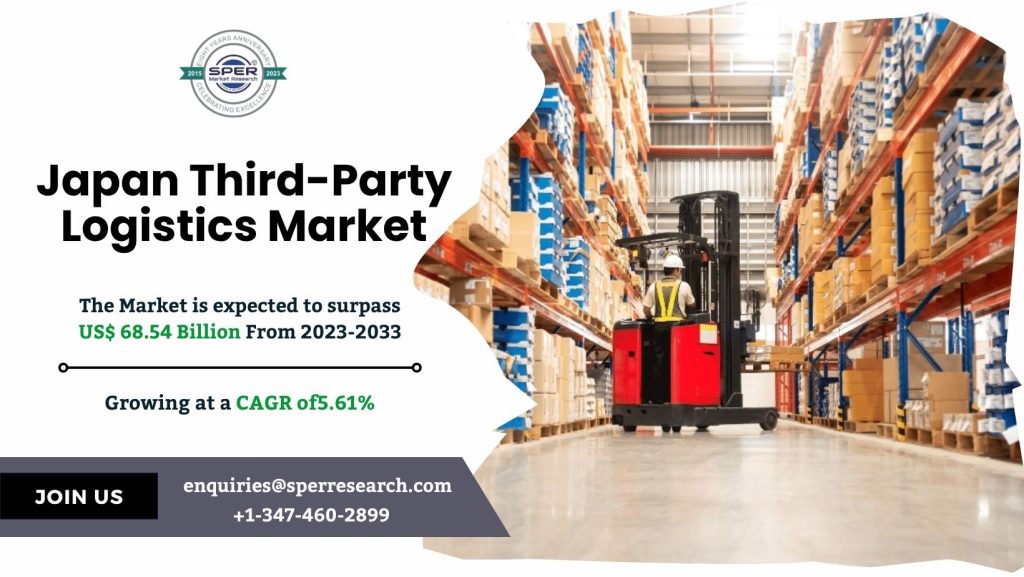
Japan Third-Party Logistics Market Trends, Size and Analysis 2033

The practice of contracting with an outside service provider to handle supply chain management and logistics is known as third-party logistics (3PL). These outside businesses are experts at managing a range of logistical tasks, including freight forwarding, distribution, order fulfillment, warehousing, transportation, and inventory control. Companies that partner with a 3PL provider can focus more on their core skills, such marketing, sales, and product development, while the 3PL handles the complex logistical processes. In order to help businesses maximize supply chain performance, lower operating costs, and boost delivery efficiency, 3PL providers frequently provide scalable and adaptable solutions that are suited to the requirements of various industries.

According to SPER market research, ‘Japan Third Party Logistics Market Size- By Transport, By Service Type, By End User- Regional Outlook, Competitive Strategies and Segment Forecast to 2033’ state that the Japan Third Party Logistics Market is predicted to reach 68.54 billion by 2033 with a CAGR of 5.61%.

Driver

Japan’s third-party logistics (3PL) sector is experiencing steady growth, largely driven by the rapid expansion of e-commerce and increasing demand for faster delivery services. Consumers’ expectations for next-day and same-day delivery have prompted businesses to outsource warehousing, order fulfillment, and last-mile logistics operations to specialized 3PL providers. Additionally, technological advancements such as automation, real-time tracking, and smart warehouse systems are enhancing supply chain efficiency, making 3PL services more attractive to companies across various industries. Industries including automotive, electronics, and pharmaceuticals are increasingly turning to 3PL providers to handle complex logistics functions, allowing them to focus on core activities and reduce operational burdens.

Japan Third-Party Logistics Market Sample in PDF Format, Click Here

Restraints:

There are several obstacles preventing the third-party logistics market in Japan from expanding and operating efficiently. The lack of truck drivers, which has been made worse by new labor laws that limit driver overtime, is one of the most urgent problems. Without widespread adoption of substitute solutions like automation or more effective routing, this is predicted to drastically reduce transport capacity in the upcoming years. Additionally, logistics providers find it challenging to build or expand modern warehouse facilities due to high land costs and the scarcity of logistics space in major cities. The fierce competition in last-mile delivery, especially in places with high population densities, is another significant issue.

The Kantō region, especially the Greater Tokyo area, leads the Japanese third-party logistics market due its dense population, sizable consumer base, and sophisticated transportation system, which fuel the nation’s highest demand for distribution and logistics services. Some of the key market players are Alps Logistics Co. Ltd., DHL, Fukuyama Biagi Logistics Inc., Kintetsu World Express Inc., Kokusai Express Co. Ltd., LOGISTEED Ltd., Mitsui-Soko Holdings Co. Ltd, and Others.

For More Information, refer to below link: –  

Japan Third-Party Logistics Market Growth

Related Reports:  

South Korea Auto Parts and Accessories Market

Europe Automotive Fuel Tank Market Size

Follow Us – 

LinkedIn | Instagram | Facebook | Twitter 

Contact Us: 

Sara Lopes, Business Consultant — USA 

SPER Market Research 

enquiries@sperresearch.com 

+1–347–460–2899

Japan Third Party Logistics (3PL) Market

Japan 3PL Market Growth, Size, Latest Trends: Top Companies, Regional Share, Industry Overview and Future Competition till 2033: SPER Market Research

Third-party logistics is the term for a company or service that helps manufacturers, particularly online retailers, outsource their distribution and logistics needs. A third-party logistics company offers specialised services such inventory management, product packing, door-to-door delivery, and cross-docking. Apart from guaranteeing scalability and reducing the risk of product damage, these services help organisations enhance consumer experiences, expand their clientele, access new markets, and complete critical internal procedures. Further aspects of the third-party logistics model that stimulate demand and aid in market expansion include partnerships for asset pooling and increased asset utilisation.

According to SPER Market Research, Japan Third Party Logistics Market Size- By Transport, By Service Type, By End Use- Regional Outlook, Competitive Strategies and Segment Forecast to 2033’ states that the Japan Third Party Logistics Market is estimated to reach USD 68.54 billion by 2033 with a CAGR of 5.61%.

The explosive rise of e-commerce in Japan has created a huge need for dependable and effective logistics services, propelling the country’s third-party logistics market. In order to meet customer expectations for precise and timely deliveries, this rise calls for sophisticated warehouse solutions, last-mile delivery services, and real-time tracking capabilities. Furthermore, in order to improve operational efficiency, globalisation and the complexity of supply chains call for complex logistical management and technological integration, including automation and the Internet of Things (IoT). The adoption of third-party logistics services is driven by the necessity of cost optimisation and the capacity to adjust to market variations. These services are crucial for organisations seeking to maintain their competitiveness and agility in a constantly changing market.

Request For Free Sample Report @ https://www.sperresearch.com/report-store/japan-third-party-logistics-market.aspx?sample=1

The third-party logistics sector in Japan is confronted with a number of obstacles, such as growing labour and salary prices that raise operating expenses and strict regulations that raise compliance costs. The market is additionally hindered by the scarcity of warehouse space and the exorbitant expense of real estate, especially in metropolitan regions. There are substantial financial constraints that come with the need to integrate cutting-edge technology, such as automation and the Internet of Things, in order to meet the rising demands for transparency and efficiency. Third-party logistics providers also need to constantly modify their logistics strategy due to the lingering effects of global supply chain disruptions and the increased complexity and cost of operating e-commerce.

The COVID-19 pandemic had a major effect on Japan’s third-party logistics sector, causing delays and shortages as well as disrupting global supply chains and raising the demand for flexible and dependable logistics solutions. Due to the pandemic’s spike in e-commerce, third-party logistics companies must make investments in automation and technology to meet the increased need for effective last-mile delivery services. Health and safety concerns limited staff availability, increasing operating expenses and deepening the employment gap. Furthermore, the pandemic highlighted the significance of supply chain flexibility and transparency, which prompted a greater focus on digital transformation and real-time tracking technologies to improve response and efficiency.

Japan Third Party Logistics Market Key Players:

Japan’s third-party logistics market was dominated by the Kanto region, especially the Greater Tokyo area. The region is a major hub for both domestic and international trade, which is fueled by its high population density, extensive transportation and logistics infrastructure, and role as a major economic hub. The key players of this market are Alps Logistics Co. Ltd., DHL, Fukuyama Biagi Logistics Inc., Kintetsu World Express Inc., Kokusai Express Co. Ltd., LOGISTEED Ltd., Mitsui-Soko Holdings Co. Ltd., Nichirei Logistics Group Inc., Nippon Express Co. Ltd., Sagawa Express Co. Ltd., Others.

Our in-depth analysis of the Japan Third Party Logistics Market includes the following segments:

By Transport:
  • Railways
  • Roadways
  • Waterways
  • Airways
By Service Type:
  • Dedicated Contract Carriage
  • Domestic Transportation Management
  • International Transportation Management
  • Warehousing and Distribution
  • Value Added Logistics Services
By End Use:
  • Manufacturing
  • Retail
  • Healthcare
  • Automo

For More Information, refer to below link: –

Japan Third Party Logistics Market Outlook

Related Reports:

North America Warehouse Robotics Market Size- By Type, By Function, By End User- Regional Outlook, Competitive Strategies and Segment Forecast to 2033

Italy Cold Chain Logistics Market Size- By Service, By Temperature Type, By Application- Regional Outlook, Competitive Strategies and Segment Forecast to 2033

Follow Us – 

LinkedIn | Instagram | Facebook | Twitter

Contact Us:

Sara Lopes, Business Consultant – U.S.A.

SPER Market Research

enquiries@sperresearch.com

+1-347-460-2899