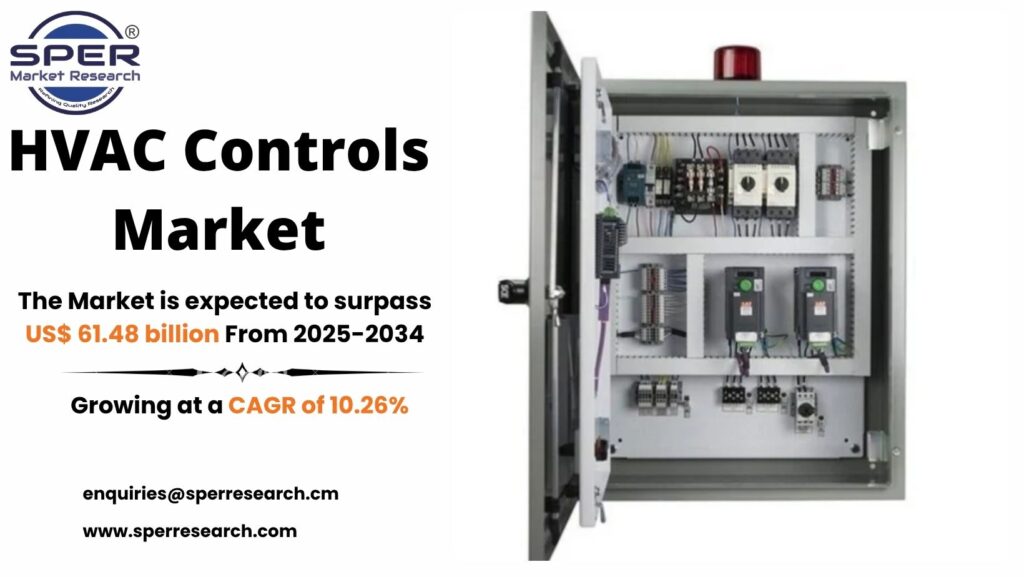
HVAC Controls Market

HVAC Controls Market Size, Share and Growth 2034

HVAC controls are automated systems crafted to regulate heating, ventilation, and air conditioning within structures. By observing and modifying equipment such as heaters, air conditioning units, and ventilation fans, these systems proficiently manage temperature, humidity, and air quality. Through automation, guided by predetermined parameters and the needs of occupants, HVAC controls enhance energy efficiency, improve comfort levels, and support sustainable building operations.

According to SPER market research, ‘Global HVAC Controls Market Size- By System, By Component, By Implementation Type, By Application – Regional Outlook, Competitive Strategies and Segment Forecast to 2034’ state that the Global HVAC Controls Market is predicted to reach 61.48 billion by 2034 with a CAGR of 10.26%.

Drivers:

The need for environmentally friendly HVAC controls and solutions is being driven by the growing emphasis on sustainability and energy efficiency. Across the globe, governments and regulatory bodies are executing stringent energy efficiency mandates aimed at reducing greenhouse gas emissions and encouraging sustainable building methodologies. This transition is particularly impactful for HVAC systems, which constitute a significant portion of a building’s overall energy expenditure. Eco-friendly HVAC alternatives provide considerable cost benefits when compared to conventional systems, with long-term gains often surpassing the initial investment. Governments and utility companies give a range of incentives, rebates, and financing options to encourage the adoption of energy-efficient devices.

Request a Free Sample Report: https://www.sperresearch.com/report-store/hvac-controls-market?sample=1

Restraints:

Investing in a new HVAC system represents a crucial choice for homeowners, as the financial commitment is spread over the lifespan of the system. The process of upgrading and establishing advanced HVAC control systems necessitates substantial investment, which can present challenges for small and mid-sized enterprises (SMEs) in the HVAC controls sector. Furthermore, HVAC systems demand meticulous fine-tuning and custom fabrication during setup to guarantee efficient operation and to avert failures, necessitating professional expertise. Should unqualified personnel undertake the installation, it may result in inefficiencies, elevated operational expenses, and potential repair costs in the future. The need for skilled labor also influences the overall installation expenses, which could deter some individuals from proceeding with the investment. In 2024, the market for HVAC controls was dominated by the Asia-Pacific region. The Asia-Pacific market is expanding as a result of growing urbanisation, a greater emphasis on energy efficiency, and an increase in construction activity. Modern HVAC systems are experiencing a surge in demand from both residential and commercial buildings as the regional economy develops. Market growth is further supported by government initiatives that promote sustainable practices and the adoption of smart technologies. Some of the key market players are Johnson Controls, Schneider Electric, Carrier Global Corporation, Daikin Industries, Honeywell International Inc, and others.

For More Information, refer to below link: –  

HVAC Controls Market Share

Related Reports:

Smart Headphones Market Growth

Smart Lighting Market Growth

Follow Us – 

LinkedIn | Instagram | Facebook | Twitter

Contact Us: 

Sara Lopes, Business Consultant — USA 

SPER Market Research 

enquiries@sperresearch.com 

+1–347–460–2899
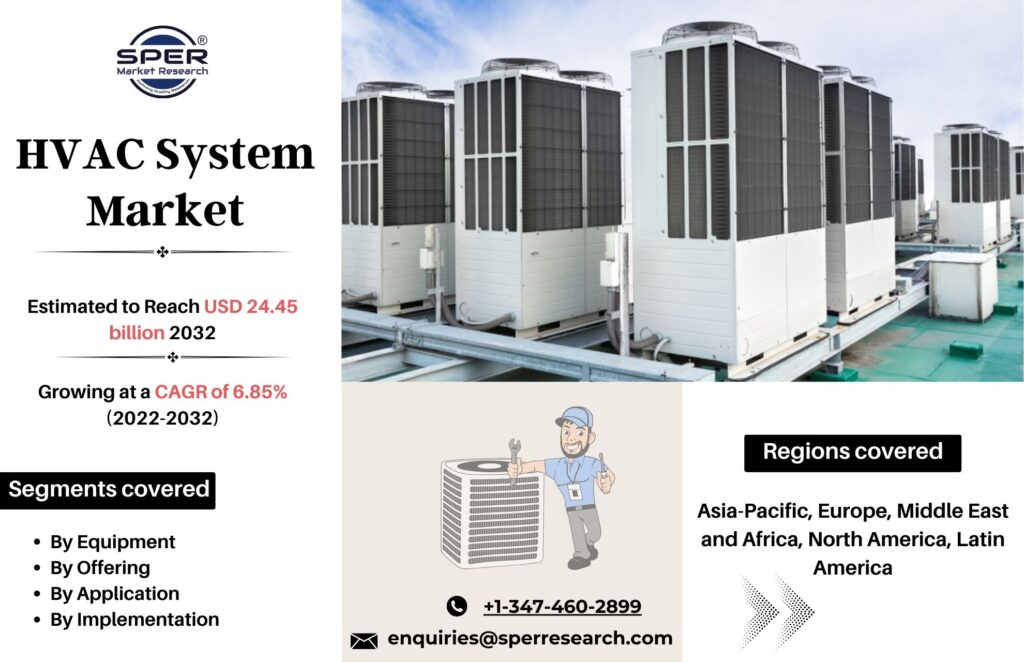
HVAC System Market

HVAC System Market Trends 2022, Industry Share, Growth Drivers, CAGR Status, Challenges, Business Opportunities, Future Strategies and Forecasts Research Report 2032: SPER Market Research

HVAC (Heating, Ventilation, and Air Conditioning) systems are critical for controlling building indoor settings. Thermal comfort is achieved by controlling temperature, humidity, and air quality. Heating is provided by furnaces, boilers, or heat pumps, whereas ventilation is the exchange of indoor and outdoor air to eliminate pollutants and maintain freshness. Cooling cycles are used in air conditioning to cool and dehumidify the indoor air. A thermostat regulates the system, while ductwork distributes heated or cooled air throughout the facility. Maintenance, such as filter replacement and system checks, is critical for optimal operation.

According to SPER market research, HVAC System Market Size- By Equipment, By Offering, By Application, By Implementation – Regional Outlook, Competitive Strategies and Segment Forecast to 2032’ state that the Global  HVAC System Market is predicted to reach USD 407.35 billion by 2032 with a CAGR of 6.85 %.

The HVAC (Heating, Ventilation, and Air Conditioning) system sector has a lot of room for growth and development. As communities and industries continue to prioritize energy efficiency, sustainability, and indoor air quality, the demand for sophisticated HVAC technology and solutions grows. A variety of causes are driving this tendency.

People are also becoming more conscious of the environmental impact of standard HVAC systems. The usage of energy-efficient HVAC solutions is becoming increasingly crucial as governments and corporations try to reduce greenhouse gas emissions.

Request For Free Sample Report @ https://www.sperresearch.com/report-store/hvac-system-and-Services-market.aspx?sample=1

Tight regulations, severe rivalry, rapid technological and economic developments, and altering customer preferences all provide challenges for the HVAC system market. Compliance with energy efficiency and environmental requirements needs ongoing innovation and investment. The market’s competitiveness necessitates differentiation, cost-effectiveness, and great customer service. Keeping up with rapidly changing technology necessitates ongoing adaptation and integration. Economic volatility and supply chain disruptions have an impact on the sector, necessitating cautious cost control. Evolving consumer expectations for bespoke, long-term solutions pose pricing and competitiveness challenges.

COVID-19 Impact on Global HVAC System Market

The pandemic of COVID-19 has had a significant influence on the HVAC system business. One of the most noticeable consequences has been a delay in maintenance and retrofitting efforts. Due to lockdowns, social distancing measures, and restricted access to facilities, many companies and houses postponed non-essential HVAC repair and upgrade work. The decline in demand for maintenance and retrofitting has impacted HVAC service providers and manufacturers’ revenue streams.

HVAC System Market Key Players:

Furthermore, the epidemic has put many businesses and individuals in financial jeopardy, making them less likely to invest in HVAC system updates or replacements.

Furthermore, BAS units that manage and monitor HVAC and other devices in specific buildings are outfitted with computerized and digital communication technologies to aid in energy conservation. Because of the rising number of construction projects and renovations, the number of integrated BAS units has increased. BAS technology has advanced due to advancements in sensor technology, lower-cost and faster communication networks, and improved user interfaces.  Additionally, some of the market key players are Arkema Group, Carrier Global Corporation, Daikin Industries Ltd., Danfoss AS, Emerson Electric Co., Fujitsu General Ltd., Gree Electric Appliances Inc., Haier Smart Home Co. Ltd., Honeywell International Inc., Havells India Ltd., Hitachi Ltd., Johnson Controls International Plc, L.G. Electronics, Lennox International Inc., LG Electronics Inc.

Global HVAC System Market Segmentation:

By Equipment {Cooling Equipment (Unitary Air Conditioners, VRF Systems, Chillers, Room Air Conditioners, Coolers, Cooling Towers), Heating Equipment (Heat Pumps, Furnaces, Unitary Heaters, Boilers), Ventilation Equipment (Air Handing Units, Air Filters, Dehumidifiers, Ventilation Fans, Humidifiers and Air Purifiers)},

By Offering {HVAC Equipment (HVAC Machine Controllers, Energy Meters, Drives, Contractors, HMIs/Displays), HVAC Services (Installation, Upgradation/replacement, Maintenance and repair, Consulting)},

By Application  {(Commercial (Office buildings, Supermarkets/hypermarkets, Government, Healthcare, Hospitality, Transportation), Industrial (Oil and gas, Food and beverage, Automotive, Energy and utilities) and Residential}

By Implementation  (New Constructions and Retrofits)

For More Information, refer to below link: –

HVAC System Market Future Outlook

Related Reports:

Mobile Threat Defence Market Size- By Component, By Operating System, By Deployment- Regional Outlook, Competitive Strategies and Segment Forecast to 2033

Morocco Data Center Market Size- By Vertical, By Co-Location, By End User- Regional Outlook, Competitive Strategies and Segment Forecast to 2033

Follow Us –

LinkedIn | Instagram | Facebook | Twitter

Contact Us:  

Sara Lopes, Business Consultant – USA

SPER Market Research

enquiries@sperresearch.com

+1-347-460-2899

HVAC System

HVAC System Market Growth, Rising Trends, Business Challenges, Share, Key Players, Future Investments and Forecast 2032: SPER Market Research

HVAC (Heating, Ventilation, and Air Conditioning) systems are essential for controlling the interior temperatures in buildings. Thermal comfort is supplied by controlling temperature, humidity, and air quality. Heating is provided by furnaces, boilers, or heat pumps, while ventilation is the exchange of indoor and outdoor air to eliminate pollutants and maintain freshness. Air conditioning uses cooling processes to chill and dehumidify the interior air. A thermostat controls the system, while ductwork distributes heated or cooled air throughout the facility. Maintenance, such as filter replacement and system inspections, is important for effective operation. To highlight energy efficiency, high-efficiency equipment and appropriate insulation are employed.

According to SPER market research, HVAC System Market Size- By Equipment, By Offering, By Application, By Implementation – Regional Outlook, Competitive Strategies and Segment Forecast to 2032’state that the Global HVAC System Market is predicted to reach USD 407.35 billion by 2032 with a CAGR of 6.85%.

The HVAC (Heating, Ventilation, and Air Conditioning) system sector offers several growth and development potential. The need for sophisticated HVAC technology and solutions is gradually expanding as societies and industry continue to focus on energy efficiency, sustainability, and indoor air quality. Furthermore, people are becoming more aware of the environmental impact of common HVAC systems. As governments and businesses work to minimize greenhouse gas emissions, the use of energy-efficient HVAC solutions becomes increasingly important. This presents an opportunity for businesses specializing in innovative and environmentally friendly HVAC systems, such as those driven by renewable energy sources or by modern heat pump technology.

Despite the potential for expansion, the HVAC System market faces a number of difficulties that may limit its growth and adoption. Strict rules and regulations, severe competition, rapid technological and economic developments, and altering customer preferences all provide challenges to the HVAC system market. Constant innovation and investment are required to comply with energy efficiency and environmental laws. The competitiveness of the market necessitates differentiation, cost-effectiveness, and great customer service. Keeping up with rapidly changing technology necessitates continuous adaptation and integration.

Request For Free Sample Report @ https://www.sperresearch.com/report-store/hvac-system-and-Services-market.aspx?sample=1

COVID-19 Impact on Global HVAC System Market

The pandemic of COVID-19 has had a significant influence on the HVAC system business. One of the most noticeable effects has been a delay in maintenance and retrofitting efforts. Many businesses and homes postponed non-essential HVAC repair and upgrade projects due to lockdowns, social distancing measures, and restricted access to facilities. The decrease in demand for maintenance and retrofitting has had an impact on the revenue streams of HVAC service providers and manufacturers.

Furthermore, the epidemic has put many businesses and individuals in a financial bind, making them more unwilling to invest in HVAC system updates or replacements.

Geographically, The HVAC system market in Europe is growing steadily due to a number of factors. Demand for sophisticated and sustainable HVAC solutions is driven by stringent environmental legislation and energy efficiency standards. Germany, the United Kingdom, France, and Scandinavia are major market contributors because they promote energy-efficient heating and cooling systems. Furthermore, the growing emphasis on green buildings and sustainable construction practices increases the region’s usage of HVAC systems. Additionally, some of the market key players are Arkema Group, Carrier Global Corporation, Daikin Industries Ltd, Haier Smart Home Co. Ltd., Havells India Ltd., Hitachi Ltd., Honeywell International Inc., Johnson Controls International Plc, L.G. Electronics, Danfoss AS, Emerson Electric Co, Fujitsu General Ltd, Gree Electric Appliances Inc.

This report also provides the data for key regional segments of North America, Europe, Asia-Pacific and Rest of the World. 
This study also encompasses various drivers and restraining factors of this market for the forecast period. Various growth opportunities are also discussed in the report.

For More Information, refer to below link: –

HVAC System Market Future Outlook

Related Reports:

Air Traffic Management Market Size- By Domain, By Component, By Application, By End User- Regional Outlook, Competitive Strategies and Segment Forecast to 2033

Morocco Data Center Market Size- By Vertical, By Co-Location, By End User- Regional Outlook, Competitive Strategies and Segment Forecast to 2033

Follow Us –

LinkedIn | Instagram | Facebook | Twitter

Contact Us:  

Sara Lopes, Business Consultant – USA

SPER Market Research

enquiries@sperresearch.com

+1-347-460-2899