Energy Storage Technology Market Analysis, Growth, Demand, Revenue, Challenges and Future Business Opportunities Till 2034: SPER Market Research

Energy storage technology refer  to systems that capture and retain energy for future utilization, assisting in balancing supply and demand within power systems. Energy storage technologies can be categorized into various types based on their conversion/storage method: chemical including electrochemical (e. g. , as in hydrogen, batteries), mechanical (e. g. , as in flywheels), electrical including electromagnetic (e. g. , as in supercapacitors, superconducting magnetic), and thermal (e. g. , as in molten salts). Regarding functionality, an energy storage technology may be directional or bidirectional; a bidirectional technology is capable not only of storing (or absorbing and storing) energy but also of providing the stored energy through the same process. Hydrogen-based reversible fuel cells are therefore classified as a bidirectional energy storage technology.

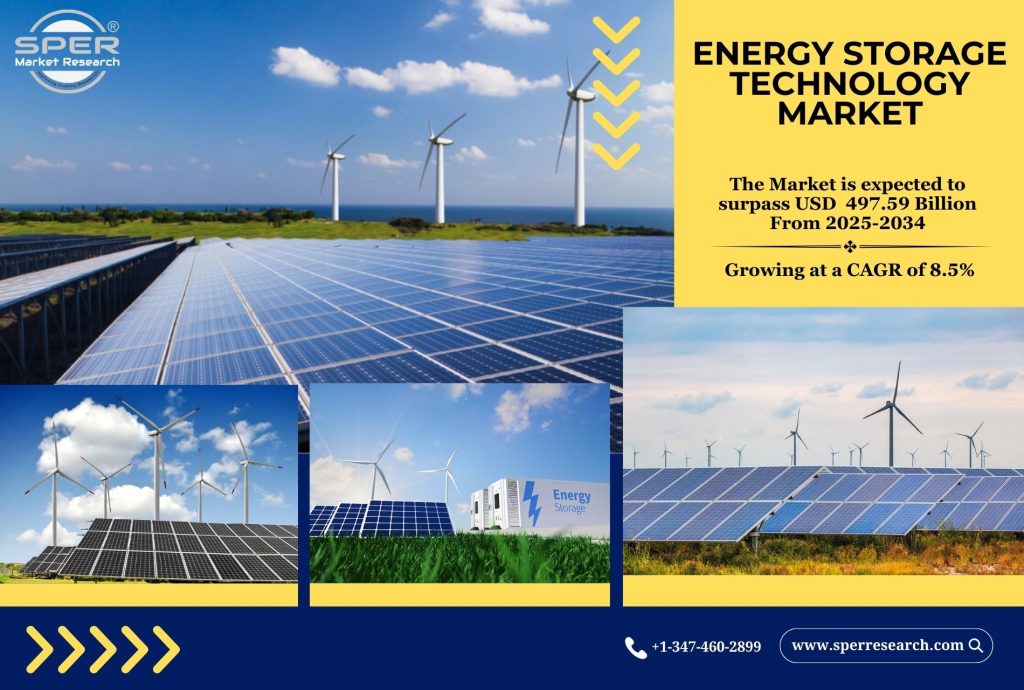
According to SPER Market Research, ’Global Energy Storage Technology Market Size- By Type, By End User – Regional Outlook, Competitive Strategies and Segment Forecast to 2034′ states that the Global Energy Storage Technology  is estimated to reach USD   497.59 billion by 2034 with a CAGR of 8.5 %.

DRIVERS: 

The increasing utilization of renewable energy sources such as solar and wind has resulted in a demand for adaptable energy storage options to handle supply variations and maintain grid stability. Energy storage systems assist in balancing sporadic generation by retaining surplus energy for future use. Utilities are progressively acknowledging the advantages of energy storage in the reduction of peak load demands, prolonging asset lifespan, and offering ancillary services. This transition is driving investments in energy storage as a financially viable substitute for conventional peaker plants. Ongoing advancements in energy storage technologies, encompassing new battery formulations and grid-scale solutions, are broadening the functions and uses of energy storage systems, rendering them more appealing to both consumers and businesses.

Request a Free Sample Report: https://www.sperresearch.com/report-store/energy-storage-technology-market.aspx?sample=1

RESTRAINTS: 

The existence of alternative energy solutions alongside conventional power generation techniques can generate competition that reduces the market share for energy storage technologies, impacting their economic feasibility. Acquiring raw materials for batteries, such as lithium and cobalt, presents difficulties due to price fluctuations and possible shortages, which may limit production capability and raise costs. Energy storage technologies need to fulfill certain performance standards to guarantee reliability and efficiency. Insufficient performance may result in doubt among users concerning their capability to provide backup power or improve grid stability. Ambiguous or vague regulations regarding energy storage can hinder innovation and investment. In the absence of clear guidelines on how storage systems are allowed to engage in energy markets, developers might be reluctant to fund new projects.

The economic decline caused by the pandemic led to a decrease in investments in residential energy storage due to financial apprehensions among consumers and businesses. It underscored the necessity for effective energy storage technologies that can accommodate variable energy requirements. Home quarantines increased residential energy demands, spurring interest in renewable energy options and their combination with storage technologies. As a result, it diminished the energy consumption used for operating businesses, public utilities, entertainment activities, etc. Additionally, numerous individuals vacated urban areas to return home where they could work remotely and escape the high costs of living in larger cities. Consequently, the demand for electricity and fuel prices were lowered, thereby putting downward pressure on wholesale electricity market prices.

The market for energy storage technology market is dominated by Asia-pacific region especially China because of its rapid economic development, increasing energy demand.  Some of its key players are- Tesla, Exide Industries, Toshiba Corporation, BYD Company Limited, EOS Energy Storage.

For More Information, refer to below link: –  

Energy Storage Technology Market Growth

Related Reports:  

Vietnam Water Heater Market Growth, Size, Trends Analysis – By Product Type, By Distribution Channel, By End User – Regional Outlook, Competitive Strategies and Segment Forecast to 2034

Air-Cooled Heat Exchanger Market Growth, Size, Trends Analysis – By Structure, By Material, By Type, By Fin Design, By End-Use Industry – Regional Outlook, Competitive Strategies and Segment Forecast to 2034

Follow Us – 

LinkedIn | Instagram | Facebook | Twitter 

Contact Us: 

Sara Lopes, Business Consultant — USA 

SPER Market Research 

enquiries@sperresearch.com 

+1–347–460–2899

Energy Storage Technology Market

Energy Storage Technology Market Share 2023- Industry Trends, Revenue, Growth Drivers, Business Challenges, CAGR Status and Future Investment till 2033: SPER Market Research

The development of energy storage technology is essential to achieving our goal of a more reliable and sustainable energy supply. It operates similarly to a larger, more powerful rechargeable battery. The goal is to store excess energy produced during periods of abundant renewable energy sources, such as the sun and wind. When the productivity of these renewable energy sources is lower, the stored energy can be used to maintain a consistent and uninterrupted power supply. Energy storage is required to make the most of renewable energy sources and lessen their intermittent nature. 

According to SPER market research, Energy Storage Technology Market Size- By Process Type, By Storage Medium, By Application, By Level of Integration, By End User – Regional Outlook, Competitive Strategies and Segment Forecast to 2033 state that the Energy Storage Systems Market is predicted to reach USD 497.59 billion by 2033 with a CAGR of 8.5%.  

Drivers: 

The increasing emphasis on producing renewable energy on a global scale is driving the energy storage systems market. The market is expected to expand quickly in the next years as the demand for reasonably priced, effective energy resources rises. Clean and renewable energy can be a low-cost alternative to fossil fuel-based electricity. By utilizing it, you can decrease greenhouse gas emissions, diversify your energy sources, and become less dependent on fossil fuels—all of which will help to lower air pollution. The number of data storage facilities is anticipated to rise during the forecast period, and a number of industries, including IT and finance, are expected to see rapid growth in competition. 

Challenges: 

The market for energy storage technologies is confronted with various challenges. A primary impediment is the expense associated with creating and implementing novel energy storage technologies. Lithium-ion batteries, pumped hydro storage, and emerging innovations are a few examples of technologies that may be difficult to widely adopt because of their high initial costs. Furthermore, the absence of consistent policies and regulations is problematic since regulatory frameworks typically find it difficult to keep up with the energy storage industry’s rapid advancements. Other issues to consider are energy density and storage length; creating technologies that can hold vast amounts of energy for protracted periods of time is still an obstacle to overcome. 

Request For Free Sample Report @ https://www.sperresearch.com/report-store/energy-storage-technology-market.aspx?sample=1

Impact of COVID-19 on Global Energy Storage Technology Market

The COVID-19 pandemic had a major effect on the global energy storage technology market. Energy storage system deployment and production were impacted by supply chain disruptions and the general economic downturn. The implementation of lockdowns and restrictions resulted in a temporary setback in the growth of the market due to delays in project timelines, construction, and installations. The industry faced additional challenges due to reduced investments and uncertainties in the financial markets during the pandemic. But the crisis also brought attention to the need for energy resilience, and as nations began to concentrate on economic recovery, the value of energy storage technology in boosting grid reliability and facilitating the integration of renewable energy sources has come to light more and more. 

Global Energy Storage Technology Market Key Players:

Furthermore, In 2021, the world’s largest market was Asia-Pacific. This was a result of the increased need for energy storage systems in nations like South Korea, India, and China. Additionally, some of the market key players are Samsung SDI Co. Ltd, Siemens, Panasonic Corporation, ABB Ltd, General Electric, Fluence Energy, Saft, Others. 

Energy Storage Technology Market Segmentation:

The SPER Market Research report seeks to give market dynamics, demand, and supply forecasts for the years up to 2033. This report contains statistics on product type segment growth estimates and forecasts.

By Process Type: Based on the Process Type, Global Energy Storage Technology Market is segmented as; Electrochemical Storage, Mechanical Storage, Thermal Storage.

By Storage Medium: Based on the Storage Medium, Global Energy Storage Technology Market is segmented as; Gaseous Storage, Liquid Storage, Solid-State Storage.

By Application: Based on the Application, Global Energy Storage Technology Market is segmented as; Commercial & Industrial, Grid Storage, Residential, Transportation, Utility.

By Level of Integration: Based on the Level of Integration, Global Energy Storage Technology Market is segmented as; Standalone Systems, Integrated Systems.

By End User: Based on the Level of End User, Global Energy Storage Technology Market is segmented as; Commercial & Industrial, Government, Residential, Transportation, Utilities, Others.

By Region: This report also provides the data for key regional segments of North America, Asia-Pacific, Latin America, Middle East & Africa and Europe.

This study also encompasses various drivers and restraining factors of this market for the forecast period. Various growth opportunities are also discussed in the report.

For More Information, refer to below link:-

Energy Storage Technology Market Revenue

Related Reports:

Asia Pacific Solar PV Inverter Market Size- By Inverter Type, By Application- Regional Outlook, Competitive Strategies and Segment Forecast to 2033

Floating Power Plants Market Size- By Power Source, By Power Rating, By Platform Type- Regional Outlook, Competitive Strategies and Segment Forecast to 2033

Follow Us –

LinkedIn | Instagram | Facebook | Twitter

Contact Us:

Sara Lopes, Business Consultant – U.S.A.

SPER Market Research

enquiries@sperresearch.com

+1-347-460-2899