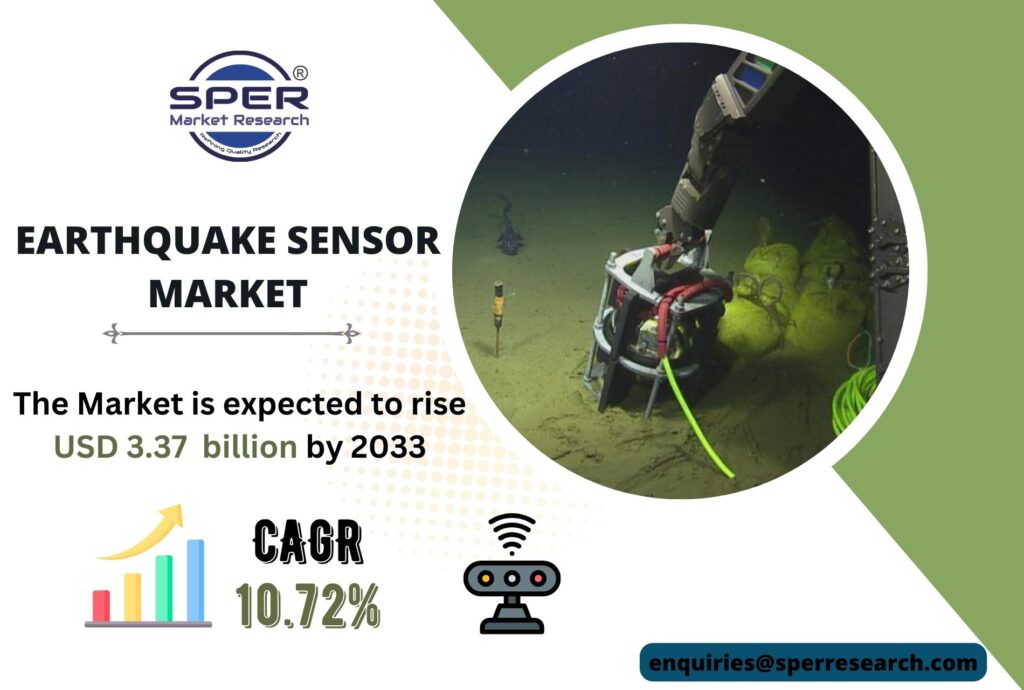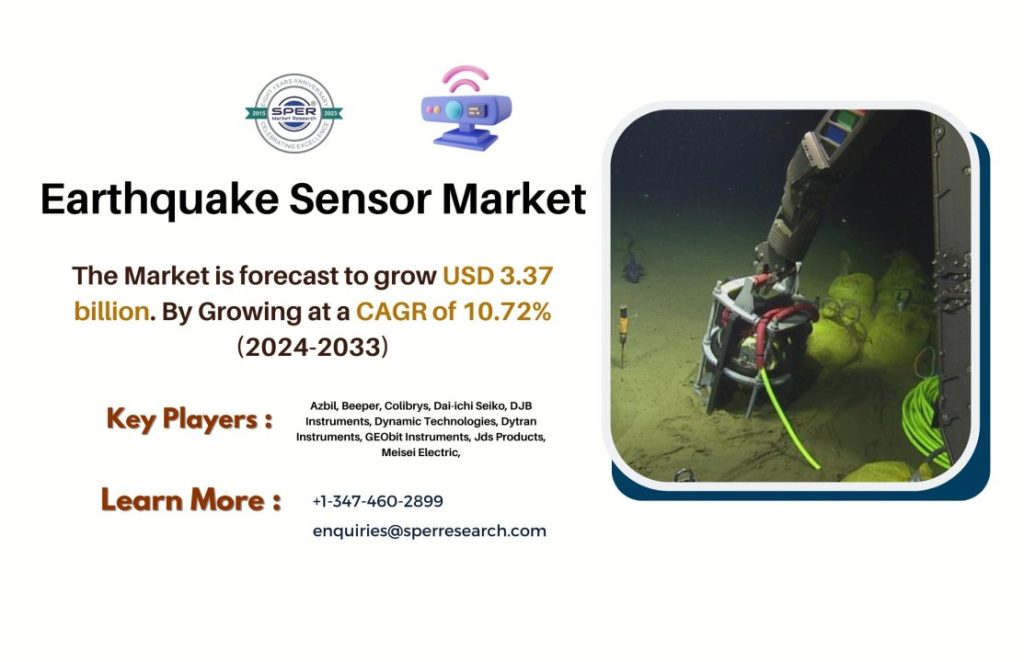
The Global Earthquake Sensor Market is thoroughly examined in the study, along with its size and trends, product mix, channels of distribution, and supplier analysis. A device used to detect seismic activity, especially earthquakes, is called an earthquake sensor. Seismologists frequently use these sensors to locate and gauge the strength of earthquakes. Their primary job is to detect seismic waves, such as compressional, transverse, love, and Rayleigh waves, that are produced during an earthquake. There are several uses for earthquake sensors in both military and civilian settings.
According to SPER market research, ‘Earthquake Sensor Market Size- By Type, By Technology, By Application, By End User- Regional Outlook, Competitive Strategies and Segment Forecast to 2033’ state that the Global Earthquake Sensor Market is predicted to reach USD 3.37 billion by 2033 with a CAGR of 10.72%.
The market for earthquake sensors is anticipated to increase significantly because of a number of important considerations. First off, the need for seismic sensors is being driven by the increasing frequency of earthquakes and their catastrophic effects on human life. Second, the defense industry has a significant need for these sensors. Furthermore, developments in sensor technology support the expansion of the market. During the forecast period, the market is anticipated to see growth due to the introduction of smart sensors that are incorporated into machinery to halt operations upon detecting seismic waves and higher government investments in seismic hazard prevention.
Additionally, the growing need for Disaster Risk Management (DRM) services and the falling prices of Earthquake Early Warning (EEW) systems are anticipated to boost the earthquake sensor market. With the use of sensors, EEW systems can identify seismic waves and promptly alert users, allowing them to take preventative measures and limit possible damage.
Request For Free Sample Report @ https://www.sperresearch.com/report-store/earthquake-sensor-market.aspx?sample=1
The worldwide market for seismic sensors has both potential and difficulties. As seismic activity increases globally, more advanced earthquake sensors are required to accurately detect and identify earthquakes. Spending on research and development has skyrocketed as a result, leading to advances in sensor technologies. Companies are focusing on developing highly sensitive, low-cost sensors that are easy to integrate into infrastructure, buildings, and smart cities.
But there are a lot of challenges facing the seismic sensor business as well. One of the biggest challenges, especially in places with limited infrastructure or resources, is the high setup and maintenance costs of advanced sensor networks. Furthermore, false alarms can result in unnecessary stress and financial losses, so it is critical to guarantee the quality and reliability of seismic data.
Impact of COVID-19 on Global Earthquake Sensor Market
The COVID-19 epidemic had a contradictory impact on the worldwide market for seismic sensors. Lockdowns and restrictions first led to problems for the market in the areas of production, supply chain, and logistics. This led to delays in product installs and debuts. The pandemic did, however, also highlight the importance of early warning systems and disaster preparedness, which increased the demand for earthquake sensors in some regions. Remote monitoring and IoT integration became more common during the pandemic, making it possible to collect and analyze data continuously. As the situation altered, the market started to show signs of recovery due to the need for robust infrastructure and state-of-the-art seismic monitoring systems.
Earthquake Sensor Market Key Players:
The market study provides market data by competitive landscape, revenue analysis, market segments and detailed analysis of key market players such as; AJds Products, Meisei Electric, Omron, QMI Manufacturing, REF TEK, Senba Denki Kazai, Sercel, Tokyo Sokushin, zbil, Beeper, Colibrys, Dai-ichi Seiko, DJB Instruments, Dynamic Technologies, Dytran Instruments, GEObit Instruments, Ubukata Industries, Others.
Global Earthquake Sensor Market Segmentation:
By Type: Based on the Type, Global Earthquake Sensor Market is segmented as; Intelligent, Normal.
By Technology: Based on the Technology, Global Earthquake Sensor Market is segmented as; Accelerometers, MEMS-based Sensors, Networked Detection Systems, Seismometers.
By Application: Based on the Application, Global Earthquake Sensor Market is segmented as; Apartment, House, Industrial Facilities, Office Building, Transportation Infrastructure, Other Buildings.
By End User: Based on the End User, Global Earthquake Sensor Market is segmented as; Governments, Private Sector, Research Institutions.
By Region: This research also includes data for Asia-Pacific, Europe, the Middle East and Africa, North America, and Latin America.
This study also encompasses various drivers and restraining factors of this market for the forecast period. Various growth opportunities are also discussed in the report.
For More Information, refer to below link:-
Earthquake Sensor Market Trends
Related Reports:
Follow Us –
LinkedIn | Instagram | Facebook | Twitter
Contact Us:
Sara Lopes, Business Consultant – U.S.A.
SPER Market Research
+1-347-460-2899