Asia Pacific Seed Treatment Market

Asia Pacific Seed Treatment Market Overview, Size and Challenges 2033

Seed treatment is the application of biological, chemical, or physical agents to seeds prior to planting in order to increase their performance and protect them from pests, diseases, and environmental stress.This method enhances seed germination, promotes early plant growth, and boosts eventual crop output. Treatments may include fungicides, insecticides, bactericides, or beneficial microorganisms. It is a cost-effective and tailored strategy for protecting crops during their most vulnerable periods of growth.  Seed treatment also minimises the need for excessive pesticide application in the field, so encouraging sustainable agriculture.  It is commonly utilised in agricultural systems for cereals, pulses, oilseeds, and vegetables.

According to SPER market research, Asia-Pacific Seed Treatment Market Size- By Application, By Crop Type – Regional Outlook, Competitive Strategies and Segment Forecast to 2033’ state that the Asia-Pacific Seed Treatment Market is predicted to reach 1.57 billion by 2033 with a CAGR of 11.53%.

Drivers:

Government initiatives and increasing awareness are key drivers in the Asia-Pacific seed treatment business. Governments are offering subsidies and assistance programs to encourage modern agricultural techniques, enabling farmers, particularly smallholders, to utilise sophisticated seed treatment procedures.Furthermore, as people become more aware of the importance of crop protection in minimising pest-related losses, the demand for treated seeds has increased.  The region’s expanding population and food demands have intensified the emphasis on high-yield crops.  Seed treatments increase crop yield and resilience, making them crucial instruments for guaranteeing food security and sustainable agriculture across Asia Pacific’s diverse and climate-sensitive farming regions.

Request a Free Sample Report: https://www.sperresearch.com/report-store/asia-pacific-seed-treatment-market.aspx?sample=1

Restraints:

The seed treatment market in Asia Pacific confronts significant hurdles, notably in terms of environmental, health, and economic issues.  Chemical-based seed treatments can contaminate soil and water, posing environmental and safety risks.  They also present health dangers to farmers during application.  Furthermore, the high cost of sophisticated seed treatment solutions restricts access for small-scale and resource-constrained farmers.  Many people lack the financial resources to invest in these technologies, preferring basic agricultural supplies over pricey upgrades.  This cost barrier prevents widespread adoption, particularly in low-income areas, making it difficult to scale advanced treatment methods throughout the region’s different agricultural populations.

Indonesia leads the Asia-Pacific seed treatment market due to its diverse agricultural landscape, which comprises a variety of climates ranging from tropical to temperate. These variances present distinct issues that necessitate appropriate seed treatment techniques. Farmers in Indonesia are increasingly recognising the need of seed treatment in protecting crops from a variety of pests and diseases that thrive in humid climates. Some of the key market players are ADAMA Agricultural Solutions Ltd, Advanced Biological Marketing Inc., BASF SE, Bayer CropScience AG, DuPont de Nemours Inc. and others.

For More Information, refer to below link: –  

Asia Pacific Seed Treatment Market Demand

Related Reports:

Agricultural Fumigants Market

Agriculture Biologicals Testing Market

Follow Us – 

LinkedIn | Instagram | Facebook | Twitter

Contact Us: 

Sara Lopes, Business Consultant — USA 

SPER Market Research 

enquiries@sperresearch.com 

+1–347–460–2899
Asia Pacific Seed Treatment Market 2024, Rising Demand, Revenue Trends, Key Players, Future Opportunities, and Forecast Analysis till 2033: SPER Market Research

Applying chemical, biological, or physical agents to seeds prior to planting in order to shield them against pests, illnesses, and adverse environmental conditions is known as seed treatment. By protecting seeds from pathogens, insects, and soil-borne diseases, this procedure seeks to improve seed health, increase germination rates, and encourage early crop growth. Fungicides, insecticides, bactericides, and nutritional coatings are examples of seed treatments. They may offer nutrients or growth stimulants to increase crop output in addition to seed protection. Because it eliminates the need for heavy pesticide use later in the plant’s life cycle, this method is both economical and environmentally beneficial when compared to other pest management techniques. Additionally, seed treatment maximises plant resilience under demanding growing conditions.

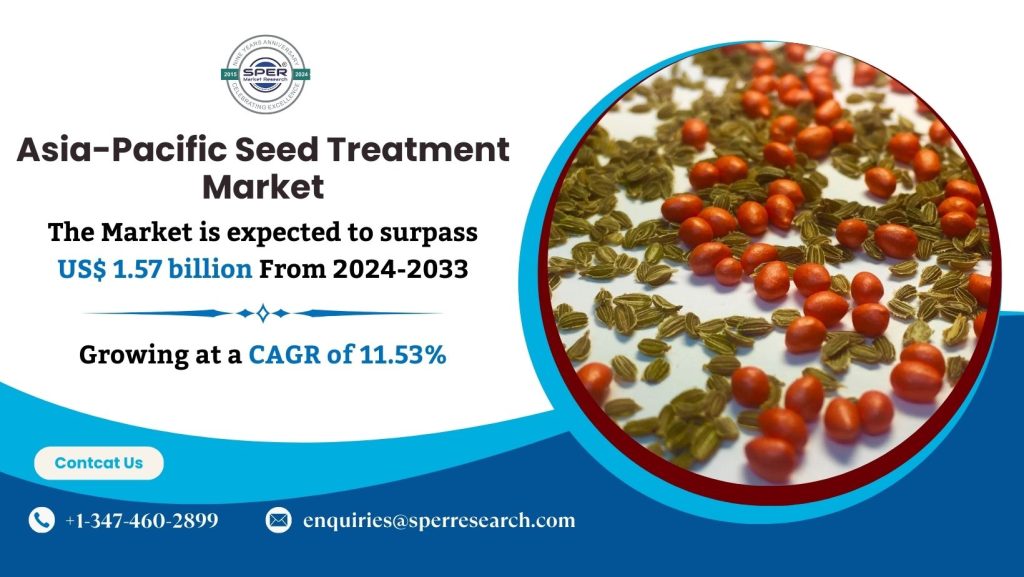
According to SPER Market Research, Asia-Pacific Seed Treatment Market Size- By Application, By Crop Type- Regional Outlook, Competitive Strategies and Segment Forecast to 2033’ states that Asia-Pacific Seed Treatment Market is estimated to reach USD 1.57 billion by 2033 with a CAGR of 11.53%.

The growing need to safeguard seeds and improve crop performance in the Asia Pacific region is fuelling the market for seed treatments. The market has seen a significant upward trend, with countries like China and India leading due to their substantial agricultural sectors. The market’s growth is further fuelled by the rising demand for food production to meet the needs of a growing population, prompting farmers to adopt seed treatments. Technological advancements in seed treatment formulations are enhancing the efficiency and precision of these applications. Government initiatives are also encouraging the adoption of seed treatments, aiming to increase seed marketability. Market acceptance is also being accelerated by farmers’ growing awareness of the long-term advantages of seed treatments.

The growth of the seed treatment market is significantly hampered by the limited compatibility of seed treatments with particular crops. The market is impacted in multiple ways by the limitation that not all crops are suitable for seed treatment. First of all, it restricts the application’s reach. Certain crops, such as ornamental plants or root vegetables, have traits that make seed treatment less efficient or even unfeasible. The whole market potential is diminished by this limitation. Second, diversification is impeded. Thirdly, adoption rates are lowered. The wider adoption of seed treatments may be hampered by farmers who predominantly grow crops that are incompatible with the technology, making them less likely to invest in it or to look for alternate approaches to pest and disease control.

Request For Free Sample Report @ https://www.sperresearch.com/report-store/asia-pacific-seed-treatment-market.aspx?sample=1

Impact of COVID-19 on Asia-Pacific Seed Treatment Market

The COVID-19 pandemic had a major effect on the Asia-Pacific seed treatment sector by delaying agricultural operations and upsetting supply chains. Manufacturing and distribution of seed treatments were impacted by lockdowns and limitations that made it difficult to transfer raw materials and completed goods. In certain areas, planting and treatment application were also hampered by a lack of labour. But because agriculture is a vital sector, the market steadily rebounded, propelled by rising demands for agricultural productivity and food security. With a stronger focus on improving crop resilience and reducing external inputs like pesticides, the pandemic also hastened the transition to sustainable agricultural methods. The market is anticipated to pick up speed with effective seed treatments as economies recover.

Asia-Pacific Seed Treatment Market Key Players:

China dominated the Asia-Pacific Seed Treatment Market due to increasing imperative for ensuring food security. Some of the key players are- ADAMA Agricultural Solutions Ltd, Advanced Biological Marketing Inc., BASF SE, Bayer CropScience AG, DuPont de Nemours Inc.

For More Information, refer to below link: –

Asia Pacific Seed Treatment Market Growth

Related Reports:

Colombia Industrial Lubricants Market Growth, Size, Trends Analysis- By Product, By End User- Regional Outlook, Competitive Strategies and Segment Forecast to 2033

Germany Gaming Console Market Growth, Size, Trends Analysis- By Type, By Applications- Regional Outlook, Competitive Strategies and Segment Forecast to 2033

Follow Us –

LinkedIn | Instagram | Facebook | Twitter

Contact Us:

Sara Lopes, Business Consultant – U.S.A.

enquiries@sperresearch.com

+1-347-460-2899

Asia-Pacific Seed Treatment Market  

APAC Biological Seed Treatment Market Share 2023, Growth Drivers, Emerging Trends, Industry Size, Revenue, Challenges, Business Opportunities and Future Competition Till 2033: SPER Market Research

Seeds treatment are used to prevent diseases that are borne on seeds as well as those that are based in the soil. Diseases borne on the soil can infect plant roots. The market demand for seed treatment has increased as a result of growing awareness of high agricultural yield and the development of organic seed treatment, which removes dangerous chemical residues from grains and other agricultural products. Agrochemicals, or crop protection chemicals, and genetically modified (GM) crop seeds make up the seed treatments market. Regarding market share and product innovations, crop protection chemicals hold the highest share in this particular segment. Among the subcategories that comprise the seed treatment market are chemical fungicides, chemical insecticides, bio-control seed treatments, and other chemical seed treatments.

According to SPER market research, Asia-Pacific Seed Treatment Market Size – By Application, By Crop Type – Regional Outlook, Competitive Strategies and Segment Forecast to 2033’ state that the Asia-Pacific Seed Treatment Market is predicted to reach USD 1.57 billion by 2033 with a CAGR of 11.53%.

The market for seed treatments is expanding rapidly due to several important factors. First of all, the need for higher crop yield and productivity has increased due to the expanding global population and the ensuing rise in food demand. Effective seed treatment, encompassing multiple technologies like coating, priming, and pelleting, is essential for enhancing seed productivity, elevating germination rates, and safeguarding against pests and illnesses. Second, there is a greater need for seed treatments, which help reduce the use of chemicals and their negative effects on the environment, as a result of increased awareness and adoption of sustainable agricultural practices.

Furthermore, one of the main factors driving the worldwide market for seed treatments is the high cost of hybrid and genetically modified seeds. A growing number of farmers are thinking about seed treatment as a means of safeguarding their investments in premium seeds due to the regulatory concerns surrounding fumigation and foliar pesticide application.

As the market for premium seeds with desired agronomic characteristics expands, it is anticipated that seed prices will increase. To guarantee high-quality seeds, businesses and farmers are prepared to invest in seed treatment technologies.

Request For Free Sample Report @ https://www.sperresearch.com/report-store/asia-pacific-seed-treatment-market.aspx?sample=1

Seed treatment market dynamics and growth potential are impacted by several challenges. The rules controlling the application of chemical seed treatment are becoming more and more onerous, which presents a big obstacle. Rules restricting the kinds and amounts of chemicals that can be sprayed on seeds are becoming more stringent as concerns about the environment and human health grow in popularity. New seed treatment product introduction is made more difficult by this, and continual innovation in the creation of sustainable and eco-friendly solutions is required.

Impact of COVID-19 on Asia-Pacific Seed Treatment Market  

The COVID-19 pandemic negatively impacted the seed treatment industry in the area by upsetting the supply chain as a result of several restrictions put in place by local government bodies. More than 85% of participants in a survey by the World Vegetable Center and the Asia-Pacific Seed Association (APSA) claimed that the COVID-19 pandemic had a detrimental impact on both domestic and international seed shipments.

Asia-Pacific Seed Treatment Market Key Players:

Furthermore, Pesticide manufacturing companies are providing a wide range of seed treatment solutions in China due to the enormous demand for seed treatment products in the country’s market. As an example, Sinochem International Crop Care Co. Ltd (Sinochem) is registered to cover crops such as corn, wheat, cotton, rice, soybean, potato, and peanut. Sinochem offers about 21 seed coating products in the nation, including different seed coating agents like insecticidal, fungicidal, and insecticidal-fungicidal mixtures. Additionally some of the market players are: BASF SE, Bayer CropScience AG, DuPont de Nemours Inc., FMC Corporation, INCOTEC Group BV, Monsanto Company, Nufarm Limited, Rallis India Limited, Sumitomo Chemical Co. Ltd, Others.

Our in-depth analysis of the Asia-Pacific Seed Treatment Market includes the following segments:

By Application:
  • Insecticide
  • Fungicide
By Crop Type:
  • Corn/Maize
  • Soybean
  • Wheat
  • Rice
  • Canola
  • Cotton
  • Others
By Region:
  • China
  • India
  • Japan
  • South Korea
  • Australia and New Zealand
  • Indonesia
  • Thailand
  • Malaysia
  • Vietnam
  • Philippines
  • Singapore
  • Rest of Asia-Pacific

For More Information, refer to below link: –

APAC Seed Treatment Market Future Outlook

Related Reports:

Africa Agricultural Films Market Size- By Type, By Application- Regional Outlook, Competitive Strategies and Segment Forecast to 2033

Micro Irrigation System Market Size- By Mechanism, By Component, By End User, By Cultivation Technology, By Application- Regional Outlook, Competitive Strategies and Segment Forecast to 2033

Follow Us – 

LinkedIn | Instagram | Facebook | Twitter

Contact Us:

Sara Lopes, Business Consultant – U.S.A.

SPER Market Research

enquiries@sperresearch.com

+1-347-460-2899

Seed Treatment Market

Seed Treatment Market Size, Growth, Demand, Emerging Trends, Investment Opportunities and Forecast SPER Market Research

According to SPER Market Research, the Seed Treatment Market is the agricultural practice of treating seeds with various chemicals, biologicals, or physical agents before planting to improve their performance and protect them from diseases and pests. The treatment is typically applied to the surfaces of the seeds or embedded in the seed coating or hull. Seed treatment aims to improve seed germination, plant growth, and yield, resulting in more productive and environmentally friendly agriculture. Seed treatments may also reduce the need for other types of chemical applications, resulting in fewer environmental consequences and lower farmer costs. Companies that manufacture and sell seed treatment products such as fungicides, insecticides, herbicides, and micronutrients, as well as seed treatment equipment and services, make up the seed treatment market. The key factors propelling the growth of the seed treatment market are the growing demand for low-cost crop protection solutions, the need to increase crop yield and quality, the need to maintain the minimum residue limit in food products, advancements in seed treatment equipment, the rising costs of high-quality seeds like hybrid and GM seeds, the advantages of seed treatment, and the rapidly declining agricultural land. Also, this market is predicted to have considerable potential due to the growing emphasis on integrated pest management, the adoption of biological seed treatment, and the advent of biodegradable seed coatings. Farmers are now required to protect these novel traits in order to ensure proper germination and crop productivity due to newly introduced varieties’ embedded innovative traits and the dramatic recent increase trend in product prices. The traditional way of applying synthetic pesticides through the process of foliar treatment has helped to reduce the number of pests, insects, and illnesses.

Seed Treatment Market Overview:

  • Forecast CAGR (2022-2032): 8.52%
  • Forecast Market Size (2032): 13.82 billion

The expansion of the market is anticipated to be driven by improvements in seed treatment technology, greater government backing, and a rise in farmer demand for high-quality seeds. Due to growing regulatory concerns around fumigation and the foliar application of pesticides, farmers are more and more seriously considering seed treatment as a way to safeguard investments made in high-quality seeds.

Impact of COVID-19 on the Global Seed Treatment Market 

The COVID-19 pandemic has forced unheard-of lockdowns worldwide, stifling regular business operations and altering customer behavior in practically every sector. Fortunately, due mostly to transportation limitations, it had little effect on the need for seed care, which was good news for the worldwide seed treatment industry. The government cannot impose lockdowns or other restrictions on any kind of agricultural business. Due to farmers’ panicked purchasing, the agrochemical businesses saw double-digit profits growth from the previous year. Businesses kept enough inventory on hand to allow farmers to purchase seed treatment goods as needed.

Several businesses, notably agriculture and crop security, were adversely affected by the lockdowns and quarantine restrictions implemented to stop the spread of the SARS-CoV-2 virus. Agrochemical movement was affected in the early stages of the outbreak by disrupted logistics and transportation. As a result, the first quarter of 2020 saw a fall in sales for the seed treatment industry. The COVID-19 pandemic caused disruptions throughout the industry’s value chain, from the supply of raw materials to manufacture, packaging, and distribution, in addition to limits on employee mobility, a drop in farmer demand, and the closure of seed production facilities. Production was hampered by the industry’s chronic labour shortages brought on by frequent lockdowns.

Request For Free Sample Report @ https://www.sperresearch.com/report-store/seed-treatment-market.aspx?sample=1

Seed Treatment Market Key Segments Covered:

The SPER Market Research report seeks to give market dynamics, demand, and supply forecasts for the years up to 2032. This report contains statistics on product type segment growth estimates and forecasts.

Global Seed Treatment Market Segmentation:

By Type: Based on the Type, Global Seed Treatment Market is segmented as; Chemical, Non-Chemical

By Application Technique: Based on the Application Technique, Global Seed Treatment Market is segmented as; Dressing, Coating, Pelleting, Others

By Function: Based on the Function Global Seed Treatment Market is segmented as; Seed Protection, Seed Enhancement.

By Crop Type: Based on the Crop Type Global Seed Treatment Market is segmented as; Cereals & Grains, Oilseed & Pulses, Fruits & Pulses, Others

By Region: Geographically, North America is anticipated to hold the greatest market share for seed treatments in previous year. The significant market share held by North America is linked to the region’s expanding domestic and international markets for high-yielding, disease-tolerant crops. Additionally, elements like a well-organized supply chain for crop protection chemicals, the accessibility of water and land, entrepreneurial farmers, rising awareness of environmentally friendly crop production methods, and the presence of numerous stakeholders all contribute to the expansion of this market in the area.

Additionally, changing climatic conditions, flexibility in sowing techniques, increased pressure from regulatory requirements, and advancing agronomic trends—which include the development of high-quality seeds through the enhanced potential offered by genetically modified organisms (GMOs)—support the growth of this regional market. Nonetheless, during the anticipated period, the East Asian market is anticipated to increase at the highest rate. This regional market is expanding as a result of factors like expanding farm sizes, rising consumer demand for high-yield crop goods, rising organic crop production in the region, particularly in China & Japan, and expanding government & organisation assistance for improving crop cultivation.

For More Information, refer to below link: –

Seed Treatment Market Size

Related Reports:

Biostimulants Market Size- By Active Ingredient, By Application, By Crop Type, By Formulation- Regional Outlook, Competitive Strategies and Segment Forecast to 2032

Brazil Agriculture Equipment Market Size- By Product Type, By Place of Production, By Tractor Power Level- Regional Outlook, Competitive Strategies and Segment Forecast to 2032

Follow Us –  

LinkedIn | Instagram | Facebook | Twitter

Contact Us:  

Sara Lopes, Business Consultant – USA

SPER Market Research

enquiries@sperresearch.com

+1-347-460-2899