Asia Pacific Electric Bus Market

Asia Pacific Electric Bus Market Trends, Size-Share, Revenue, Growth Drivers, Challenges, Key Manufacturers and Opportunities Till 2033 by SPER Market Research

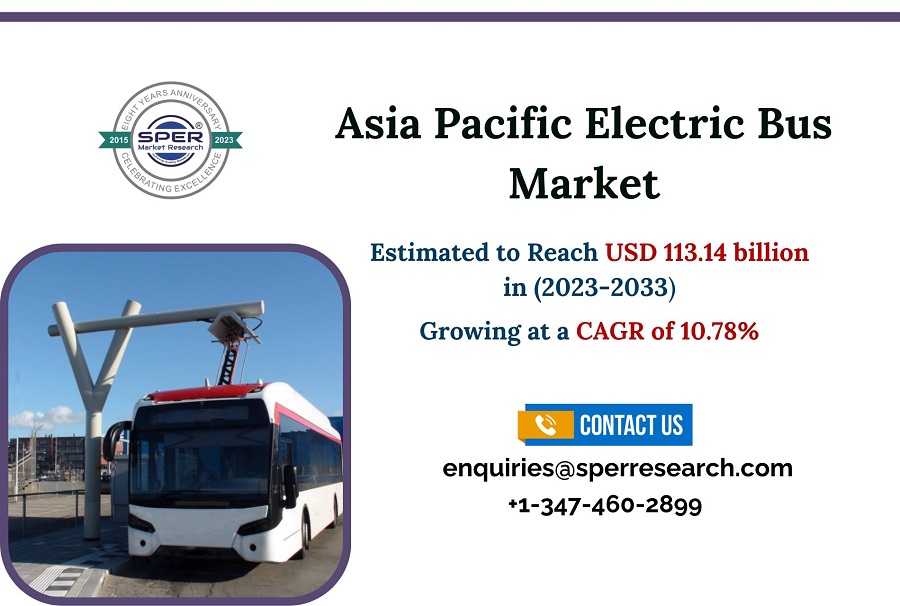
The battery electric bus is a vehicle that runs on electricity. In this sort of vehicle, the electric motor is powered by both the onboard battery and external power sources. Charging electric buses is more complicated than refuelling a diesel vehicle. The charging process must be continuously watched and attended to in order to be optimised. It is commonly used in public transportation. In contrast, an electric bus is charged at a power station by connecting to an electric grid. The bus’s battery system stores electricity to power the electric engine. These modes of transportation require less maintenance than fuel-powered buses since their engines contain fewer components than internal combustion engines.

According to SPER Market Research, Asia Pacific Electric Bus Market Size- By Vehicle Type, By Power Source Type, By Consumer – Regional Outlook, Competitive Strategies and Segment Forecast to 2033’ states that the Asia Pacific Electric Bus Market is estimated to reach USD 113.14 billion by 2033 with a CAGR of 10.78%.

Drivers: Urbanisation and environmental concerns are a couple of the key reasons driving the Asia-Pacific electric bus market. Urbanisation and population growth are contributing to elevated levels of traffic congestion and pollution. Consequently, contemporary societies are exploring eco-friendly modes of transportation to mitigate these issues. Green urban mobility plans incorporate the use of electricity as a power source for buses, as it is considered environmentally benign due to its minimal impact on the environment. The use of electric buses is expanding due to new trends in major cities, such as the establishment of low emission zones and stringent emission regulations.

Restraints: The primary issue with electric buses is that, even with government assistance, their high initial cost makes them expensive to purchase. The process of adopting electric buses and purchasing the necessary recharging equipment is capital-intensive. The transit authorities in many rising economies, like Vietnam and Indonesia, have not been able to obtain the necessary money for 2023 and 2024. The expense of improved battery technology remains a financial barrier, but one that is rapidly decreasing. There are initiatives to lessen the burden of the costs on local governments and operators, but they have not yet been fully implemented. These initiatives include public-private partnerships and international funding.

Request For Free Sample Report @ https://www.sperresearch.com/report-store/asia-pacific-electric-bus-market.aspx?sample=1

The Asia Pacific Electric Bus market had a significant drop during the COVID-19 pandemic due to industrial shutdowns, lockdowns, and trade restrictions. Furthermore, the decline in vehicle production, restrictions on public transportation, and a labour shortage all had a substantial impact on the market. Automotive manufacturers have resumed operations in nations with a low number of COVID-19 instances, and the market is expected to rebound during the projected period. Furthermore, manufacturers are putting in place contingency measures to alleviate future business uncertainty and maintain continuity with clients in important sectors of the vehicle industry.

Key Players: 

China is currently in the forefront of the adoption of electric buses thanks to sensible government regulations and sufficient funding for the industry. By employing electric buses, which are common in big cities, the government is focussing on reducing carbon emissions and improving the quality of the air in urban areas. Major players in the market are Anhui Ankai Automobile Industries Co. Limited, Ashok Leyland Limited, BYD Auto Co. Limited, King Long United Automotive Co. Limited, and Others.

Asia Pacific Electric Bus Market Segmentation:

By Vehicle Type: Based on the Vehicle Type, Asia Pacific Electric Bus Market is segmented as; Battery Electric Bus, Plug-in Hybrid Bus.

By Power Source Type: Based on the Power Source Type, Asia Pacific Electric Bus Market is segmented as; DC/AC Inverter, DC/DC Converter, DC/DC Boost Converter, E-Motor, AC/DC Charger, Motor Controller.

By Consumer: Based on the Consumer, Asia Pacific Electric Bus Market is segmented as; Government, Fleet Operators.

By Region: This report also provides the data for key regional segments of China, India, Japan, South Korea, Rest of South Africa.

This study also encompasses various drivers and restraining factors of this market for the forecast period. Various growth opportunities are also discussed in the report.

For More Information, refer to below link:-

Asia Pacific Electric Bus Market Outlook

Related Reports:

South East Asia Luxury Car Market Size- By Vehicle Type, By Fuel Type, By Price Range- Regional Outlook, Competitive Strategies and Segment Forecast to 2033

Switzerland Used Car Market Size- By Vehicle Type, By Vendor Type, By Fuel Type, By Sales Channel- Regional outlook, Competitive Strategies and Segment Forecast to 2033

Follow Us –

LinkedIn | Instagram | Facebook | Twitter

Contact Us:

Sara Lopes, Business Consultant – U.S.A.

SPER Market Research

enquiries@sperresearch.com

+1-347-460-2899

Asia-Pacific-Electric-Bus-Market

Asia Pacific Electric Bus Market Growth, Trends, Share, Demand, Key Players, Future Opportunities and Forecast Analysis till 2033: SPER Market Research

A form of public transportation vehicle known as an electric bus operates solely on electricity, as opposed to fossil fuels like gasoline or diesel. The electric motor that pushes the bus is powered by enormous batteries that store electrical energy. Compared to their conventional counterparts, electric buses are thought to be a greener and cleaner mode of transportation because they don’t use conventional fuel sources.

According to SPER market research, Asia Pacific Electric Bus Market Size- By Vehicle Type, By Power Source Type, By Consumer- Regional Outlook, Competitive Strategies and Segment Forecast to 2033’ state that Asia Pacific Electric Bus Market is predicted to reach USD 113.14 billion by 2033 with a CAGR of 10.78%.

Due to a number of factors, the electric bus industry in Asia Pacific has been growing quickly in recent years. The growing need for clean transportation solutions is a result of growing concerns about environmental sustainability, which is one of the key drivers of growth. Compared to conventional fossil fuel-powered buses, electric buses are seen to be a more environmentally friendly and sustainable option because they produce no emissions. In addition, a number of regional governments have started providing financial rewards and subsidies to public transportation companies that wish to promote the usage of electric buses.

Request For Free Sample Report @ https://www.sperresearch.com/report-store/asia-pacific-electric-bus-market.aspx?sample=1

The introduction of electric buses necessitates a network of extensive charging infrastructure. The use of electric buses is growing throughout India. The lack of infrastructure for charging electric buses continues to be a significant barrier. One big problem is the lack of fast-charging stations and other charging infrastructure. Due to the scarcity of charging outlets in many Indian towns, operators of electric buses are concerned about charging accessibility and range anxiety.

Impact of COVID-19 on Asia Pacific Electric Bus Market

The COVID-19 epidemic caused manufacturing stoppages, lockdowns, and trade restrictions, which significantly reduced the Asia Pacific electric bus industry. In addition, the market was greatly impacted by labour shortages, limitations on using public transportation, and a decline in vehicle output. The market is expected to rebound during the projection period as automakers have resumed operations as a result of consistently increasing car sales in nations with a low number of COVID-19 instances. Moreover, the automakers are putting backup plans in place to lessen potential business disruptions and maintain customer relationships in the vital areas of the automotive industry.

Asia Pacific Electric Bus Market Key Players:

In China, India, Malaysia, South Korea, Japan, Indonesia, and the rest of Asia-Pacific, the market for electric buses is examined. China dominated the market and is anticipated to continue growing in the coming years. The Asia-Pacific region has the largest market share for electric buses. This is a result of the local population’s growing desire for environmentally friendly transportation options. A number of nations, including China, Japan, and South Korea, have made financial investments in the advancement of electric bus technologies. As a result, the number of businesses in the region that manufacture electric buses has increased. The local market has expanded thanks in part to a number of government initiatives aimed at encouraging the use of electric buses. Additionally, the key market players are EV, Scania AB, Tata Motors Limited, Volvo Group, Zhong tong Bus Holding Co. Limited.

Asia Pacific Electric Bus Market Segmentation:

By Vehicle Type: Based on the Vehicle Type, Asia Pacific Electric Bus Market is segmented as; Battery Electric Bus, Plug-in Hybrid Bus.

By Power Source Type: Based on the Power Source Type, Asia Pacific Electric Bus Market is segmented as; DC/AC Inverter, DC/DC Converter, DC/DC Boost Converter, E-Motor, AC/DC Charger, Motor Controller.

By Consumer: Based on the Consumer, Asia Pacific Electric Bus Market is segmented as; Government, Fleet Operators.

By Region: This report also provides the data for key regional segments of China, India, Japan, South Korea, Rest of South Africa.

This study also encompasses various drivers and restraining factors of this market for the forecast period. Various growth opportunities are also discussed in the report.

For More Information, refer to below link:-

Asia Pacific Electric Bus Market Forecast

Related Reports:

Brazil Electric Vehicle Market Size- By Type of Vehicles, By Distribution Channel- Regional Outlook, Competitive Strategies and Segment Forecast to 2033

Netherlands Electric Vehicle Market Size- By Vehicle Type, By Battery Type, By Charging Infrastructure Trends, By Propulsion Technology- Regional Outlook, Competitive Strategies and Segment Forecast to 2033

Follow Us –

LinkedIn | Instagram | Facebook | Twitter

Contact Us:

Sara Lopes, Business Consultant – U.S.A.

SPER Market Research

enquiries@sperresearch.com

+1-347-460-2899

Asia-Pacific-Electric-Bus-Market

Asia Pacific Electric Bus Market Trends, Growth Opportunities, Share, Key Manufacturers, Future Challenges and Forecast 2023- 2033: SPER Market Research

A form of public transportation vehicle known as an electric bus uses electricity as its fuel rather than fossil fuels like petrol or diesel. These buses are propelled by an electric engine that is fuelled by enormous batteries that store electrical energy. Electric buses are regarded as a cleaner and more environmentally friendly mode of transportation than their conventional counterparts because they do not rely on conventional fuel sources. Additionally, compared to diesel buses, electric buses are frequently quieter, which can lessen noise pollution in urban areas. Governments and transport agencies around the world are trying to minimise their carbon footprint and improve air quality, which is why electric buses are growing in popularity in many places.

According to SPER market research, Asia Pacific Electric Bus Market Size- By Vehicle Type, By Power Source Type, By Consumer- Regional Outlook, Competitive Strategies and Segment Forecast to 2033’ state that the Asia Pacific Electric Bus Market is predicted to reach USD 113.14 billion by 2033 with a CAGR of 10.78%.

The Asia-Pacific region will experience rapid urbanisation, rising environmental concerns, mandatory emission and fuel economy standards, increasing government initiatives in the form of subsidies and rebates, rising use of electric vehicles, and the replacement of heavy-duty diesel and gasoline-run buses with zero-emission buses, all of which will hasten the growth of the electric bus market. The Asia-Pacific electric bus market will also have growth prospects due to the increasing need for electrification of mass transit, technological advancements with creative transportation sector initiatives, and government banking.

However, the electric bus market will be adversely affected by changes in government incentives and legislation. For instance, the Chinese government said that it would stop funding electric buses by 2020, which could raise the price of electric buses there.  Furthermore, the development of electric buses in growing nations like India is being held back by rising expenses associated with them, costly infrastructure development expenditures, and the installation of charging stations.

Request For Free Sample Report @ https://www.sperresearch.com/report-store/asia-pacific-electric-bus-market.aspx?sample=1

Furthermore, due to a serious shortage of raw materials and other electric components, the COVID-19 epidemic has had a negative effect on electric buses in the Asia-Pacific area. The Asia-Pacific region’s market for electric buses is expected to rebound during the projected period, though, as temporary restrictions on travel and cargo have been lifted by local governments. As a result, the desired components for the manufacture of electric buses can now be transported.

Geographically, China makes up the greatest portion of the market for electric buses in the Asia-Pacific region. Additionally, some of the market key players are Anhui Ankai Automobile Industries Co. Limited, Ashok Leyland Limited, BYD Auto Co. Limited, Others.

For More Information, refer to below link:-

Asia Pacific Electric Bus Market Future Outlook

Related Reports:

Saudi Arabia Tire Market Size- By Product Type, By Vehicle Type, By Design, By Distribution Channel, By End-Use- Regional Outlook, Competitive Strategies and Segment Forecast to 2033

Russia Electric Cars Market Size- By Technology, By Product, By Battery, By Battery Capacity, By End User- Regional Outlook, Competitive Strategies and Segment Forecast to 2033

Follow Us –

LinkedIn | Instagram | Facebook | Twitter

Contact Us:

Sara Lopes, Business Consultant – U.S.A.

SPER Market Research

enquiries@sperresearch.com

+1-347-460-2899

Asia Pacific Electric Bus Market

Asia Pacific Electric Bus Market Share and Growth, Trends Analysis, rise at a Highest CAGR of 10.78%, Future Challenges and Business Investment to 2023-2033: SPER Market Research

According to SPER Market Research, Asia Pacific Electric Bus Market Size- By Vehicle Type, By Power Source Type, By Consumer – Regional Outlook, Competitive Strategies and Segment Forecast to 2033’ state that the Asia Pacific Electric Bus Market is predicted to reach USD 113.14 billion by 2033 with a CAGR of 10.78%.

Electric buses are a form of public transportation that runs on electricity instead of conventional fuels like gasoline or diesel. They use large batteries to store electrical energy, which powers an electric motor that propels the bus. In contrast to regular buses, electric buses are viewed as a more environmentally friendly mode of transportation because they do not rely on fossil fuels. Additionally, electric buses are usually quieter than diesel buses, making them a more desirable option for city areas where noise pollution is a concern. Because of this, governments and transportation authorities worldwide are progressively embracing electric buses to minimize their carbon footprint and improve air quality.

The Asia Pacific electric bus market has been growing rapidly in recent years due to increasing demand for sustainable transportation options driven by rising environmental concerns. Governments in the region have also been providing financial incentives and subsidies to promote the adoption of electric buses by public transportation agencies. Technological advancements in battery technology have improved the efficiency and practicality of electric buses, resulting in longer battery life and improved charging infrastructure. The growing urbanization in the region has also provided a significant opportunity for the electric bus market to grow further in the coming years.

Request For Free Sample Report @ https://www.sperresearch.com/report-store/asia-pacific-electric-bus-market.aspx?sample=1

The Asia Pacific electric bus market faces several challenges despite experiencing rapid growth. The high initial cost of electric buses, limited range, longer charging time, inadequate charging infrastructure, lack of standardization in battery technology and charging infrastructure, and a lack of awareness and understanding of electric buses among policymakers and the public are some of the challenges that need to be addressed. Overcoming these challenges is crucial for the continued growth and success of the Asia Pacific electric bus market.

Impact of COVID-19 on Asia Pacific Electric Bus Market:

The COVID-19 pandemic caused a decline in demand for public transportation services, including electric buses, leading to a slowdown in their production and sales, and supply chain disruptions. Financial difficulties faced by transportation agencies and private bus operators made it challenging to invest in new electric buses, and the pandemic also temporarily halted the construction of charging infrastructure. Despite these challenges, some countries in the Asia Pacific region continued to invest in the electric bus market, driven by their post-pandemic recovery plans and the need for more sustainable transportation options. As the region recovers from the pandemic, the Asia Pacific electric bus market is expected to continue growing due to government policies, technological advancements, and increasing demand for sustainable transportation solutions.

Furthermore, the electric bus market in Asia Pacific is set to grow steadily, and China is currently the biggest market for electric buses due to the presence of many electric bus manufacturers and government initiatives to reduce emissions in public transport before 2030. India is also experiencing rapid growth in the electric bus market, largely due to the government’s efforts to purchase 50,000 electric buses and make all public transportation carbon neutral by 2030. As a result of these factors, the sale of electric buses in Asia-Pacific is expected to grow at a healthy compound annual growth rate (CAGR). In addition, some of the market key players are Anhui Ankai Automobile Industries Co. Limited, Ashok Leyland Limited, BYD Auto Co. Limited, King Long United Automotive Co. Limited, Others.

Asia Pacific Electric Bus Market Segmentation:

By Vehicle Type: Based on the Vehicle Type, Asia Pacific Electric Bus Market is segmented as; Battery Electric Bus, Plug-in Hybrid Bus.

By Power Source Type: Based on the Power Source Type, Asia Pacific Electric Bus Market is segmented as; DC/AC Inverter, DC/DC Converter, DC/DC Boost Converter, E-Motor, AC/DC Charger, Motor Controller.

By Consumer: Based on the Consumer, Asia Pacific Electric Bus Market is segmented as; Government, Fleet Operators.

By Region: This report also provides the data for key regional segments of China, India, Japan, South Korea, Rest of South Africa.

This study also encompasses various drivers and restraining factors of this market for the forecast period. Various growth opportunities are also discussed in the report.

For More Information, refer to below link:-

Asia Pacific Electric Bus Market Future Growth

Related Reports:

France Used Cars Market Size- By Market Structure, By Type of Used Car, By Fuel Type, By Kilometers Driven, By Ownership Period, By Car Brand- Regional Outlook, Competitive Strategies and Segment Forecast to 2032

KSA EV Charging Equipment Market Size- By Type of Vehicles, By Types of Chargers, By Type of Collectors, By Type of Ecosystems, By Source of Manufacturing, By Application- Regional Outlook, Competitive Strategies and Segment Forecast to 2032

Follow Us –

LinkedIn | Instagram | Facebook Twitter

Contact Us:

Sara Lopes, Business Consultant – U.S.A.

SPER Market Research

enquiries@sperresearch.com

+1-347-460-2899